Last updated October 9, 2026
Choosing the Right ADU Brand: A Buyer’s Guide for Los Angeles
Here is a statistic most ADU marketing never mentions: between 2019 and 2022, at least four venture-backed prefab ADU startups launched in California with the promise of 90-day builds. Most have since closed, been acquired, or paused operations. The reason is straightforward. Los Angeles plan check alone, before a permit is even issued, routinely runs four to eight months. No manufacturer controls that clock. This guide will walk you through what actually matters when choosing an ADU brand in Los Angeles: the delivery model, the permit path, the contract language, and the warranty structure. For a deeper dive, see The Complete Guide to ADU in Los Angeles. If you are spending $150,000 to $400,000 on a backyard unit, you deserve to know which numbers in the brochure are real and which ones disappear the moment you apply for your first permit.
Quick Answer
Choosing the right ADU brand in Los Angeles is not about picking between prefab manufacturers. It is about picking between three delivery models: custom stick-built, factory-built modular, and panelized/kit-of-parts. Each one moves through LADBS plan check differently, carries different total costs, and puts different warranty obligations on the homeowner. In Los Angeles, the most dependable choice for most lots is either a custom stick-built ADU or a factory-built modular unit installed by a licensed general contractor who handles the site work, foundation, utilities, and permits under one written contract. Our Complete ADU Builders Guide for Los Angeles Homeowners breaks down how to vet these contractors.
Table of Contents
- The Three ADU Delivery Models in Los Angeles
- Hidden Costs: What Manufacturer Marketing Leaves Out
- How to Check a Company’s LA Permit Track Record
- Warranty and Liability: Prefab vs. Custom Build
- What Written Accountability Looks Like in an ADU Contract
- Los Angeles Code, Climate, and Lot Realities
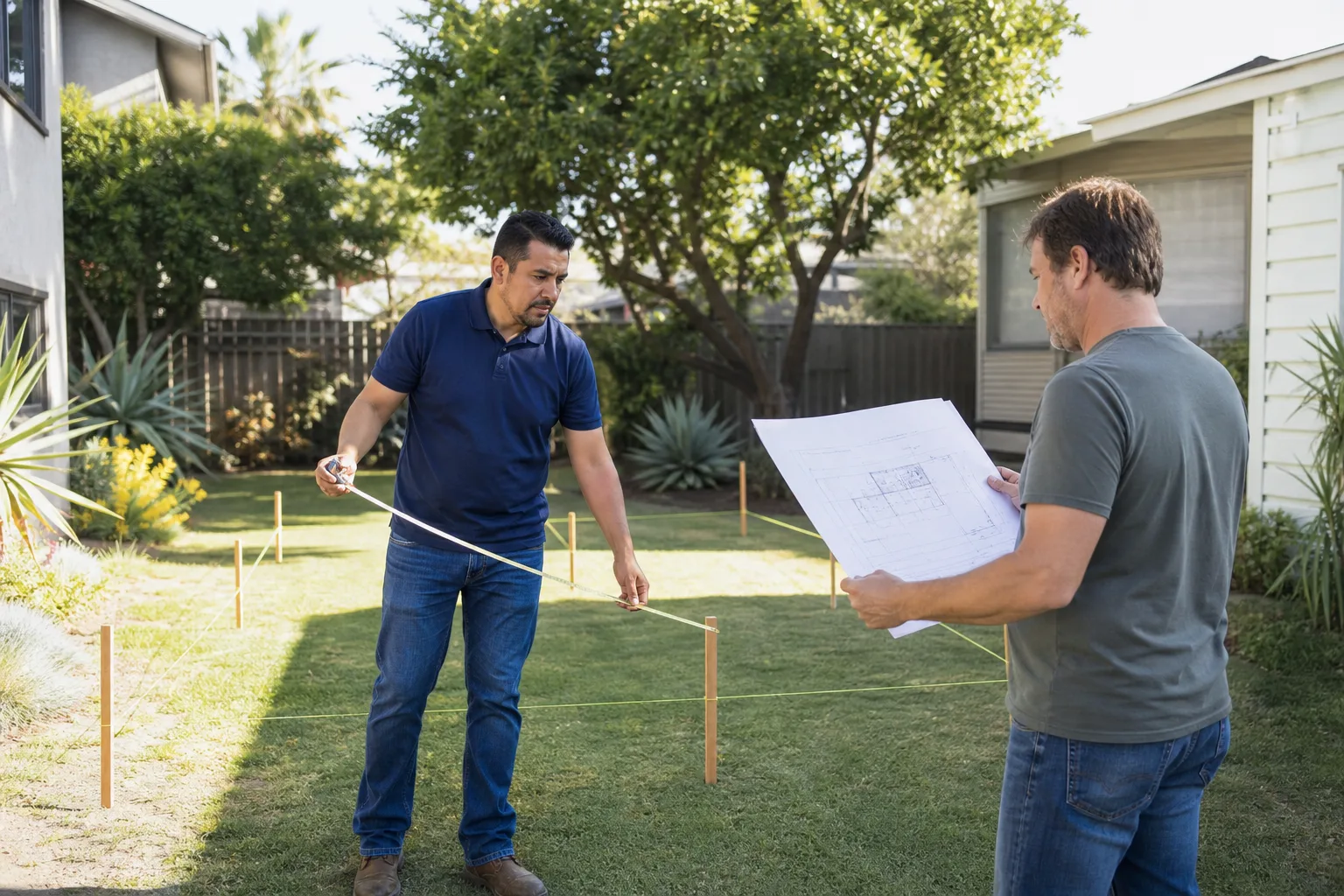
- A Step-by-Step Method for Evaluating Any ADU Company
The Three ADU Delivery Models in Los Angeles
Every ADU brand in Los Angeles fits into one of three categories, and the category matters more than the brand name. Custom stick-built ADUs are framed on-site, one stud at a time, by a general contractor. Factory-built modular ADUs are constructed in a warehouse, delivered on a truck, and set on a prepared foundation. Panelized or kit-of-parts systems fall somewhere between: walls and roof panels are cut in a factory, flat-packed, and assembled on-site. Each model produces a different permit path, a different construction timeline, and a different set of risks.
Custom stick-built is the oldest approach and still the most common in Los Angeles. The general contractor drafts plans, submits them to LADBS, pulls the permit, and builds everything on your lot. This is the slowest method on paper, but it is also the most flexible. If your lot has a weird slope, a tight setback, or a sewer line in an inconvenient place, the contractor adjusts the design before the permit is filed. You are not locked into a factory floor plan.
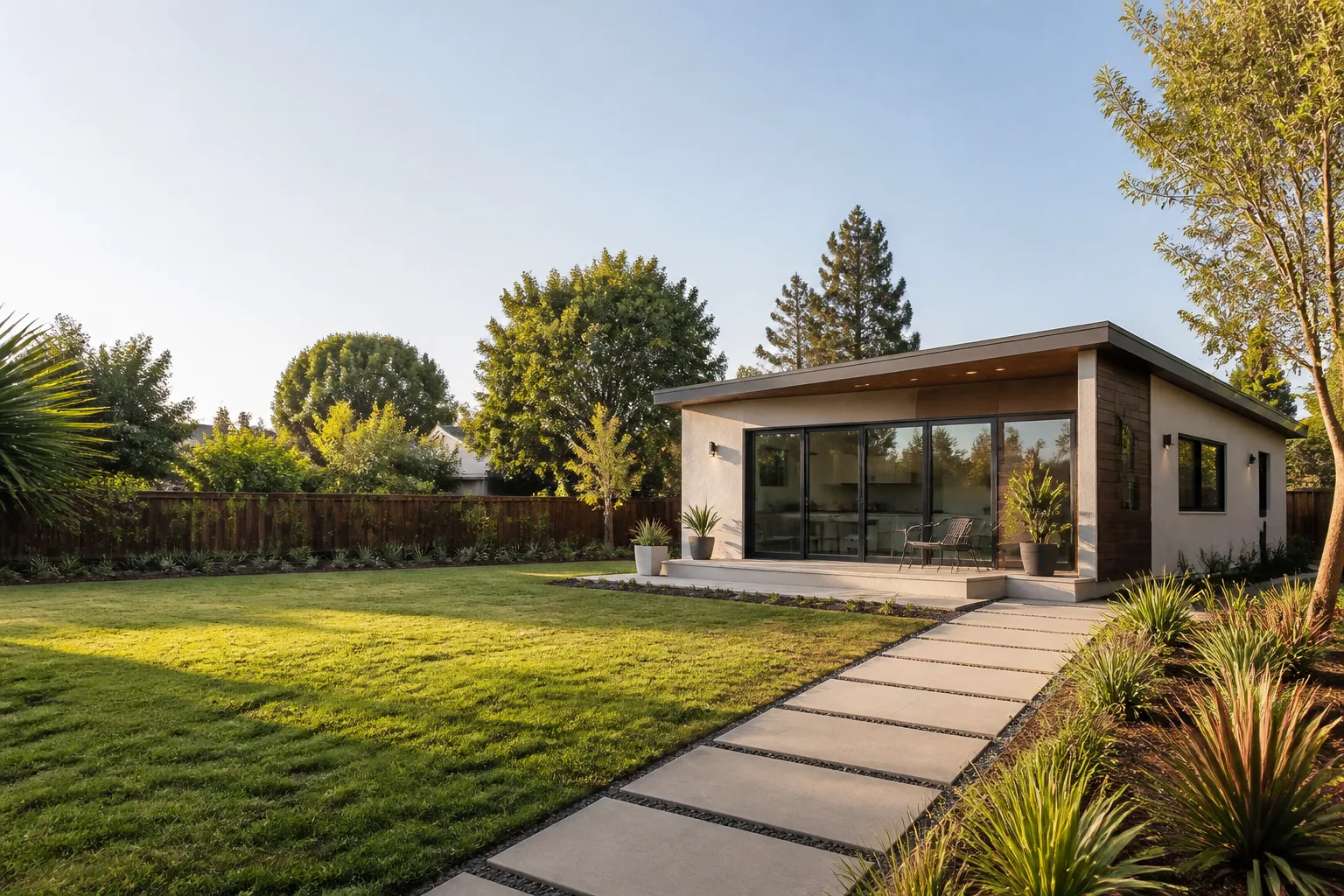
Factory-built modular ADUs are the category most people mean when they say “ADU brand.” Companies like Abodu and Cover build units in a controlled facility, ship them to your property, and place them with a crane. The factory process is faster and cleaner. The catch is that the factory only builds the box. Everything under it and around it, the foundation, the utility trenching, the electrical service, the sewer connection, happens in the field. In Los Angeles, that field work requires its own permit and its own contractor.
Panelized and kit-of-parts systems, including Dvele and certain Tuff Shed-style structures, fall into a gray zone. Some panels arrive with pre-installed insulation and wiring chases. Others are closer to a fancy shed that still needs framing, drywall, and finish work. The permit treatment varies. In our experience, panelized systems in Los Angeles often end up requiring nearly the same site work as a custom build, with slightly faster framing and slightly higher material costs.
Here is the breakdown in plain terms:
- Custom stick-built: framed and finished on-site; most flexible for odd lots; permits handled entirely by your general contractor.
- Factory-built modular: built in a warehouse; fastest shell delivery; still needs site foundation, utilities, and finish permits.
- Panelized/kit-of-parts: factory-cut panels assembled on-site; middle ground on speed and cost; permit treatment varies by product.
No single model is always better in Los Angeles. A flat lot in Reseda with easy utility access is a strong candidate for a modular unit. A hillside lot in Silver Lake with a 15-foot grade change usually makes more sense as a custom stick-built ADU. The brand should follow the lot, not the other way around.
Hidden Costs: What Manufacturer Marketing Leaves Out
The most misleading number in prefab ADU marketing is the unit price. You will see “starting at $189,000” on a manufacturer’s website. What that number does not include is everything required to make the unit legal and livable on your Los Angeles lot. Foundation, site prep, utility connections, permit fees, soils reports, and finish work can add $60,000 to $120,000 to the final total. That is not a markup from a greedy contractor. That is what LADBS and LADWP require before anyone can occupy the unit.
A factory-built modular ADU needs a site-specific foundation permit, just like a custom build. The manufacturer’s standard plans, even if they carry HCD approval, do not cover the soil conditions at your address. If the soils report shows expansive clay, which is common in parts of the San Fernando Valley, the foundation engineer may need to deepen the footings or add steel reinforcement. That cost appears on your invoice, not in the brochure.
Utility connections are another line item that disappears from marketing. Los Angeles Department of Water and Power charges for new electrical service, and the trench from your main panel to the ADU can run 20 feet or 120 feet depending on your lot layout. Sewer connections require a licensed plumber and a separate inspection. If your main sewer line is cast iron and failing, tying into it may trigger a partial replacement. None of this is optional, and none of it is included in a modular unit’s base price.
Here is a realistic cost picture for a factory-built ADU in Los Angeles, based on projects we have reviewed:
- Factory unit (base): $150,000 to $250,000 depending on size and finish level
- Foundation and site prep: $18,000 to $45,000
- Utility connections (electric, water, sewer): $12,000 to $35,000
- Permit fees and school district fees: $8,000 to $20,000
- Soils report and structural engineering: $4,000 to $10,000
- Landscaping restoration and final grading: $5,000 to $15,000
A custom stick-built ADU in Los Angeles typically runs $280 to $420 per square foot, all-in, before permit fees. A garage conversion often comes in lower, between $120,000 and $200,000, because the foundation, walls, and roof already exist. Those numbers are not tidy marketing figures, but they are real. If a manufacturer’s quote does not line up with them, ask what is missing. Go to our ADU Builders in Los Angeles page if you want to see how we structure our estimates so the line items are visible before you sign.
How to Check a Company’s LA Permit Track Record
Any contractor can claim they have built ADUs in Los Angeles. Few can prove it. The fastest way to separate a legitimate ADU company from a marketing operation is to ask for five completed project addresses, then look up each address on the LADBS public permit portal. It takes ten minutes, and it tells you more than any sales pitch.
LADBS keeps a searchable database of every permit issued, inspected, and closed in the city. You enter the address, and the system shows the permit type, the issue date, the inspection history, and the current status. A permit that is still open five years after it was issued is a red flag. It can mean the project was never completed, never passed final inspection, or was abandoned. A closed permit with a certificate of occupancy is the opposite. That is proof the company actually finished the job and the city signed off on it.
Here is the exact sequence we recommend:
- Ask the ADU company for the street addresses of five completed projects in Los Angeles.
- Look up each address on the LADBS Building Records portal.
- Check that each address has an ADU or accessory dwelling unit permit on file.
- Confirm the permit status reads “CofO Issued” or “Finaled,” not “Open” or “Expired.”
- Check the inspection history for any notes about failed inspections or stop-work orders.
- Compare the permit issue date to the completion date to get a real sense of the company’s timeline.
If a company will not provide addresses, walk away. There is no legitimate reason to hide completed work. In our experience, the companies with the strongest track records are proud to share addresses, because they know what the permit portal will show. We maintain a list of completed Los Angeles ADU projects, and we encourage prospective clients to check every one of them. A company that builds by the book has nothing to hide from a public database.
Warranty and Liability: Prefab vs. Custom Build
When you buy a prefab ADU, you are entering into two separate warranty relationships. The manufacturer warrants the factory-built unit. The installing contractor, if it is a different company, warrants the site work. If the roof leaks where the factory unit meets the site-built foundation, you may find yourself in the middle of two companies each saying the other one is responsible. This is not a hypothetical issue. It is the most common warranty dispute in modular ADU construction.
A custom stick-built ADU built by a licensed general contractor puts everything under one warranty. The contractor is responsible for the foundation, the framing, the roof, the electrical, the plumbing, and the finish work. If something fails, there is one phone number to call and one company obligated to respond. That structure is simpler for the homeowner, and it is the reason many Los Angeles buyers choose custom construction even when a modular unit would be faster.
Warranty length matters, but what matters more is whether the warranty is written down and enforceable. Manufacturer warranties on modular units typically run one to two years on workmanship and ten years on structural components, but they are often limited to the factory-built portions only. A general contractor’s workmanship warranty should cover the entire structure, including the parts the contractor built on-site. The question to ask any ADU company, prefab or custom, is this: what exactly does your warranty cover, how long does it run, and what happens if a defect shows up at month eleven?
Our answer to that question is specific. Fielding ADU Builders backs every ADU with the 365-Day Done Right Promise. If something fails during the first year, we come back and correct it at no charge. The guarantee is written down, not spoken. It covers workmanship defects on the entire project. That is what accountability looks like on paper, and it is the standard we recommend homeowners hold every ADU company to, regardless of which delivery model they choose. See our Fielding ADU Builders home page to understand the full scope of what we build and how we warranty it.
What Written Accountability Looks Like in an ADU Contract
Most ADU contracts in Los Angeles are written to protect the contractor, not the homeowner. Change orders, allowances, and open-ended line items create room for the price to move after work begins. A homeowner who has already been burned once should read every ADU contract with the same question in mind: if the project goes sideways, what does this piece of paper actually guarantee?
At Fielding ADU Builders, we hold ourselves to what we call The Garrison Code: show up in the window, put the price in writing, build by the book, leave it clean, and stand behind it for a year. That is not a slogan. It is a five-point operating procedure that every project follows. The written price comes before any work starts. The permit is pulled before any demo begins. The guarantee is spelled out on paper: what it covers, how long it runs, and exactly how we make it right if something fails.
Here is what to look for when you review an ADU contract from any company:
- A fixed price, not an estimate: the number you approve on day one should be the number on the final invoice.
- A defined scope of work: every line item listed, from demolition to final paint.
- A permit clause: the contractor must pull the permit and close it out with a certificate of occupancy.
- A written warranty: the guarantee should be on the contract itself, with the duration stated in days or months.
- A change-order procedure: any change to scope should require your written sign-off before work proceeds.
- A payment schedule tied to milestones: not to dates, but to completed inspections and delivered work.
If a company hands you a two-page contract with a lump-sum number and a vague scope, ask for more detail. A legitimate ADU contractor in Los Angeles will provide a written line-item estimate without hesitation. We do it for every project, including garage conversions and room additions, because a written price protects both sides. The homeowner knows the number will not drift. The contractor knows the scope will not balloon. That is the whole point of putting it on paper.
Los Angeles Code, Climate, and Lot Realities
Los Angeles is not one market. It is a patchwork of hillside zones, flat-valley lots, coastal fog belts, and inland heat pockets. Each one imposes different constraints on ADU construction, and the right delivery model varies by address. The ADU brand that works for a flat lot in Lake Balboa may be a poor fit for a hillside lot in Echo Park.
Setbacks are the first thing to check. California state ADU law limits how much local jurisdictions can restrict ADU construction, but Los Angeles still enforces side and rear setbacks in most residential zones. A setback variance, the city’s written permission to build closer to the property line than the standard rule allows, is sometimes required for narrow lots. That variance adds time to the permit review and is not included in any manufacturer’s timeline. A custom contractor can file for the variance as part of the drawings. A modular manufacturer may require you to handle it separately.
Hillside lots bring additional requirements. The Los Angeles Department of Building and Safety requires a soils report and a detailed foundation plan for any ADU on a slope over a certain grade. The foundation may need piers, caissons, or retaining walls. A factory-built modular unit can still work on a hillside, but the crane access and foundation engineering often erase the cost advantage. We have seen hillside ADUs in Mount Washington and Glassell Park where the site work cost more than the unit itself.
Climate matters less for ADUs than for larger structures, but it still shapes material choices. Coastal neighborhoods like Playa del Rey and San Pedro deal with salt air and marine moisture, which affects siding and flashing choices. Inland areas like Woodland Hills and Granada Hills experience 100-degree summer days, which means insulation and HVAC sizing need attention. A well-designed ADU uses James Hardie fiber cement siding in coastal zones for moisture resistance, and a properly sized mini-split system everywhere, because Los Angeles summers are getting hotter and longer.
The practical takeaway: before you fall in love with a brand, know your lot. Check the zoning, the setback rules, the sewer line location, and the slope. Those four factors will narrow your delivery model options faster than any brochure.
A Step-by-Step Method for Evaluating Any ADU Company
If you are serious about building an ADU in Los Angeles, here is the process we recommend. It works whether you are evaluating a national prefab brand, a local modular installer, or a custom general contractor. Follow these steps in order, and you will avoid most of the mistakes that leave Los Angeles homeowners with half-finished projects and an open permit file.
- Check the license: verify the contractor’s license status on the CSLB website. Confirm it is active, has no recent suspensions, and the classification covers residential construction.
- Ask for five completed ADU addresses: then check each one on the LADBS permit portal as described above. Look for closed permits with certificates of occupancy.
- Request a written line-item estimate: not a ballpark number. The estimate should show foundation, framing, electrical, plumbing, HVAC, drywall, finish, and permit fees as separate categories.
- Ask about the permit path: who files the drawings, who pulls the permit, who schedules inspections, and who closes the permit out. If the answer is anyone other than the contractor, ask more questions.
- Read the warranty language: does it cover the entire structure or only part? How long does it run? What is the process for making a claim? Get the warranty in writing before you sign.
- Visit a completed project: ask to see a finished ADU the company built. If possible, talk to the homeowner. Ask about the timeline, the change orders, and what happened after final inspection.
- Compare total cost, not base price: add foundation, utilities, permit fees, and site work to any prefab unit price before comparing it to a custom build quote.
This process takes a few hours of phone calls and public-record research. It is the difference between buying an ADU with your eyes open and buying a set of renderings. For more on how we approach the build itself, see our Garage Conversion Contractor in Los Angeles page, which details how we handle one of the most common ADU paths in the city.
Common Mistakes to Avoid
- Buying the unit before checking the lot: a buyer falls for a modern prefab design, pays a deposit, then discovers the lot has a 10-foot grade change that makes crane placement impossible. Always evaluate the lot first.
- Believing the “90-day build” marketing: no manufacturer controls the LADBS plan check timeline, which is often four to eight months before a permit is issued. Budget for the permit clock.
- Comparing base prices across delivery models: a $189,000 modular unit and a $260,000 custom build may cost nearly the same after foundation, utilities, and permits are added to the modular price. Compare total cost, not the sticker.
- Skipping the permit portal check: a contractor’s portfolio photos prove nothing. The LADBS permit record proves whether the project was actually completed and inspected.
- Signing a contract without a written warranty: a verbal promise to “take care of anything” is worthless. The warranty must be on paper, with a defined duration and a defined scope.
- Assuming the manufacturer’s HCD approval covers your lot: state approval speeds up part of the review, but your foundation, utilities, and site conditions still require local permits and inspections.
- Choosing the cheapest bid: the lowest ADU bid in Los Angeles is often the one with missing line items that reappear as change orders once the project is underway. A written, itemized price is worth more than a low number with blank spaces.
When to Call a Professional
If you have a lot with any kind of complexity, a slope, a narrow side yard, an old sewer line, an existing unpermitted structure, or a tight setback, do not try to navigate the Los Angeles permit process alone. The ADU code is state-mandated but locally administered, and the gap between what the state allows and what LADBS will approve is where projects stall. A licensed general contractor who has built ADUs in Los Angeles knows which drawings the plan checker will request, which inspections the field inspector will fail, and which foundation types the soils engineer will require. Fielding ADU Builders offers free estimates in Los Angeles. Call (361) 315-4177 to schedule yours. We will walk the lot with you, pull the zoning records, and give you a written price before any work starts.
Frequently Asked Questions
A custom stick-built ADU in Los Angeles typically runs $280 to $420 per square foot, all-in, before permit fees, which puts most projects between $150,000 and $400,000 depending on size, site conditions, and finish level. Garage conversions run lower, often between $120,000 and $200,000, because the foundation and shell already exist. Call (361) 315-4177 for a written line-item estimate specific to your lot.
Not always. A prefab unit’s base price excludes foundation, utility connections, permit fees, and site work, which can add $60,000 to $120,000 to the total. Once those costs are included, a factory-built modular ADU and a custom stick-built ADU on the same lot often land within 10 to 15 percent of each other.
The construction itself typically takes four to seven months once the permit is issued, but plan check at LADBS routinely adds another four to eight months before construction can begin. Any timeline that does not include the permit review period is not a real timeline. Homeowners should budget twelve to eighteen months from signing to occupancy.
Yes, in most cases. LADBS requires a soils report and a site-specific foundation plan for ADUs on slopes and for many flat lots with expansive soils. The manufacturer’s HCD approval covers the factory-built unit but does not replace the site-specific engineering your property requires.
A manufacturer warranty covers only the factory-built portions of a prefab unit. A contractor warranty should cover the entire structure, including the foundation, utilities, and site work. Before you sign any ADU contract, confirm that the warranty is written down, states how long it runs, and identifies who is responsible if a defect appears.
Ask for the street addresses of five completed projects, then look up each address on the LADBS public permit portal. Confirm each permit status reads “CofO Issued” or “Finaled.” An open or expired permit is a sign the project was never completed or never passed final inspection. Call (361) 315-4177 if you want help reviewing a contractor’s track record before you commit.
The Bottom Line
The ADU brand question in Los Angeles is really a delivery model question. Custom stick-built, factory-built modular, and panelized systems each carry different permit paths, timelines, and total costs. The brand name on the brochure matters less than the contract language, the permit track record, and the warranty structure. Before you commit to any ADU company, check five completed project addresses on the LADBS portal, demand a written line-item estimate, and confirm the warranty is on paper. Browse our more guides & resources for additional Los Angeles ADU research. An ADU is a six-figure investment. The right choice is the company that puts its price in writing, pulls its permits, and stands behind the work for a full year.
Written by Reed Calloway, Owner at Fielding ADU Builders, serving Los Angeles since 2006.