
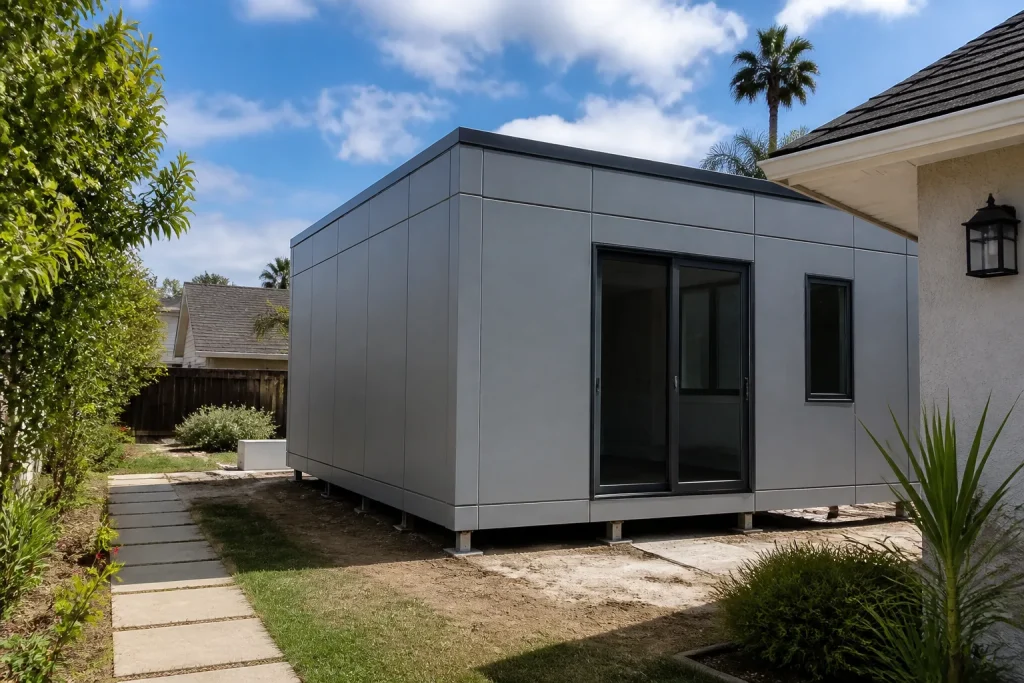
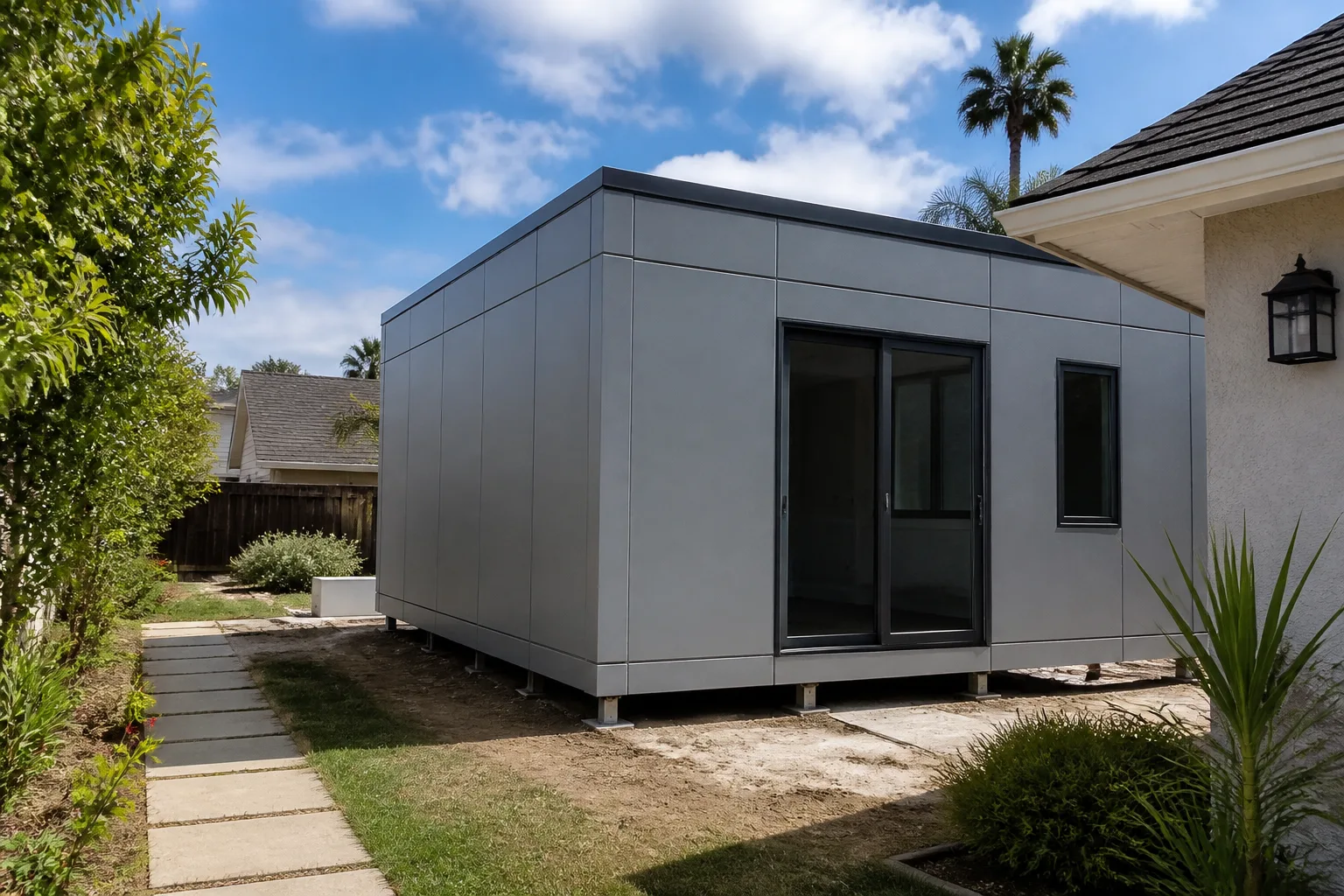
Boxabl Room Addition Contractor in Los Angeles: A Homeowner’s Guide
Boxabl’s Casita has generated enormous media attention, but as of right now, most Los Angeles homeowners searching for one will hit the same wall: a waitlist measured in months, sometimes longer, and a delivery footprint that doesn’t yet cover every LA County address. The real question isn’t whether Boxabl is a good product. It’s what happens when you plan a project around a unit that may not arrive on schedule, and how a local contractor should structure the contract to protect you when those timelines shift. We’ve pulled one Boxabl unit out of a homeowner’s garage in Sherman Oaks last month where the box sat for nine weeks after delivery because the foundation wasn’t ready. That’s the gap this guide closes.
If you’d rather skip the details and talk pricing, call (361) 315-4177 for a free estimate. Otherwise, here’s what you need to know before you sign anything.
Key Takeaways
- Boxabl’s Casita is a factory-built ADU shell that still requires full site work: foundation, utilities, setbacks, and final inspection by a licensed Los Angeles contractor.
- Current waitlists for Boxabl delivery to LA County addresses routinely run six to eighteen months, and that timeline can shift after you’ve paid a deposit.
- California HCD approval matters more than Boxabl’s marketing: your LA inspector will ask for the state insignia and the installation manual before anything gets approved.
- Your contract must name who holds the deposit, what triggers a timeline extension, and what your exit rights are if the unit doesn’t arrive.
- Total project cost for a Boxabl-based ADU in Los Angeles typically lands between $180,000 and $260,000 once site work, permits, and utility connections are included. A conventional or prefab-panel ADU of equivalent size often falls in the same range, sometimes lower, but with fewer delivery unknowns.
What Boxabl Actually Delivers, and What It Doesn’t
Boxabl’s Casita is a compact, factory-assembled dwelling unit that arrives folded flat on a truck and unfolds on site to roughly 375 square feet of living space. It ships with drywall, windows, doors, a bathroom, and a kitchenette already installed. That’s the part homeowners understand. The part they miss is what the box does NOT include: a foundation, utility hookups, site grading, setback compliance, permit approval, and the final sign-off from a Los Angeles building inspector. None of that arrives on hand.
In our experience across Los Angeles, the most common Boxabl mistake is treating the unit like a finished house that just needs to be set down. It’s not. It’s a highly finished prefab component. The site work around it is still a licensed contractor’s job, and the permit still runs through the Los Angeles Department of Building and Safety under California factory-built housing rules. If you’re comparing Boxabl to a conventional ADU build, the honest comparison is total project cost, not the price of the box.
Current Delivery Reality for LA County Addresses
Boxabl has been public about scaling production since its Nevada factory came online, and the company’s order backlog has at times been reported in the tens of thousands of units. For a Los Angeles homeowner placing a deposit today, the practical wait is typically six to eighteen months, and that’s before the unit gets scheduled on a truck to Southern California. We’ve spoken with LA homeowners in Mar Vista, Woodland Hills, and Burbank whose delivery dates moved more than once after the deposit cleared. It’s not that the company is unreliable; it’s that the demand curve has been steep and the production ramp has been slower than the marketing.
Dozens of Los Angeles homeowners have paid deposits to ADU contractors based on Boxabl delivery timelines that later shifted by months, leaving them with site prep costs, permit expirations, and no unit. A Los Angeles building permit for an ADU is generally valid for twelve months from issuance, with extensions possible but not automatic. If your Boxabl arrives in month fourteen and you didn’t extend the permit, you’re re-filing and re-paying. A responsible contractor structures the contract around that reality instead of pretending it doesn’t exist.
California HCD Approval and What Your LA Inspector Will Ask For
Boxabl’s Casita is designed to meet California’s factory-built housing standards, which means it falls under California Department of Housing and Community Development (HCD) oversight rather than a purely local stick-built permit path. That’s good for homeowners because HCD approval happens at the state level before the unit ever reaches Los Angeles. But it’s not a bypass. The city of Los Angeles still has to approve the site work, the foundation, the utility connections, and the final installation.
When the inspector shows up, they’ll ask for three things: the HCD insignia on the unit itself, the installation manual from the manufacturer, and a site plan showing setbacks, utility routing, and foundation details. Setback variance is the city’s written permission to build closer to the property line than the standard rule allows, and in dense Los Angeles neighborhoods like Echo Park or West Adams, that variance is often the difference between a project that fits and one that has to be redesigned. A local contractor who has pulled Los Angeles ADU permits before will know which questions the plan checker asks before they get asked.
Site Work That Must Happen Regardless of Manufacturer
No matter which factory-built unit you choose, whether it’s a Boxabl Casita, a Plant Prefab studio, or a Tuff Shed-style backyard structure, the site work is nearly identical and it’s all Los Angeles-specific:
- Foundation. Most LA ADUs sit on a raised concrete or pier-and-grade-beam foundation. Soil conditions vary by neighborhood: the clay soils in the San Fernando Valley move differently than the sandy fill near Playa del Rey.
- Utility connections. Water, sewer or septic tie-in, and electrical service. In Los Angeles, sewer lateral connection to the main line often requires a separate permit and can add a week to the schedule.
- Setback compliance. Los Angeles requires ADUs to sit at least four feet from side and rear property lines in most residential zones. Narrow lots in neighborhoods like Highland Park and Jefferson Park almost always need a variance or a redesign.
- Final inspection. The city signs off on the complete installation, not just the box. That means the foundation, the connections, and the finished unit all get checked together.
This is where a licensed local contractor earns the fee. The box itself is the part the factory already did. The site is the part where Los Angeles gets specific, and it’s the part that goes wrong when a homeowner hires a generalist who doesn’t know the ADU ordinance from the last code cycle.
How a Responsible Contract Should Handle Manufacturer Delay
If you’re planning a Los Angeles Boxabl project, the contract is the single most important document you’ll sign, because the manufacturer’s timeline is outside your contractor’s control. In our experience, the contractors who get referrals are the ones who put the delay provisions in writing before the deposit changes hands.
Here’s what a responsible contract should include:
- Who holds the deposit. If the contractor holds the Boxabl deposit and the manufacturer delays by a year, you want that escrowed or clearly refundable. If the manufacturer holds it, the contract should say so and tell you how to get it back if the timeline slips past a stated date.
- A timeline extension trigger. The contract should name the specific event that allows the schedule to move: manufacturer delay, permit appeal, weather. Not a vague “unforeseen circumstances” clause that lets the contractor move the date at will.
- Your exit rights. If the unit hasn’t shipped by a certain date, say month twelve or month eighteen, you should have the right to cancel without forfeiting your deposit, or to swap to a different build method (conventional, prefab-panel) without a re-bid from scratch.
We write these provisions into every Los Angeles ADU contract we sign, and we’d recommend any homeowner ask for the same. If a contractor won’t put the delay terms in writing, that’s the answer.
Boxabl vs. Conventional vs. Prefab-Panel ADU: Real Los Angeles Cost Comparison
Here’s the honest cost picture for a roughly 400-square-foot permitted ADU in Los Angeles, comparing a Boxabl-based project to a conventional stick-built ADU and a prefab-panel system like Plant Prefab:
- Boxabl Casita project. The unit itself is often quoted in the $70,000 to $90,000 range, but that’s the box. Site work (foundation, grading, utility connections), Los Angeles permit fees, delivery, crane or lift placement, and the contractor’s management fee typically add $110,000 to $170,000. Total project cost: roughly $180,000 to $260,000, and the delivery date is uncertain.
- Conventional stick-built ADU. For the same 400 square feet, Los Angeles contractors currently bid between $220,000 and $320,000 depending on finish level and site conditions. The schedule is more predictable because the materials are ordered from local suppliers, not from a factory queue. And you’re not paying for a brand name; you’re paying for lumber, labor, and on-site construction.
- Prefab-panel ADU (Plant Prefab, or similar). The sweet spot for many LA homeowners. Panels are cut in a factory, shipped flat, and assembled on site in weeks rather than months. Total project cost for 400 square feet typically runs $200,000 to $280,000, with a delivery window measured in weeks, not quarters.
The honest takeaway: Boxabl’s price advantage shrinks once you add the site work every Los Angeles ADU needs. The people who win with Boxabl are those with patient timelines, simple lots, and a contractor who wrote the delay terms down. The people who lose are the ones who paid a deposit assuming the box would arrive on the manufacturer’s original date.
When to Call a Pro
If you’re weighing a Boxabl against a conventional or prefab-panel build and you already own the lot, the moment to call a contractor is before you put down a deposit anywhere. The contractor’s site assessment will tell you things the manufacturer can’t: whether your slope needs a retaining wall, whether your sewer line can handle the connection, whether your setback needs a variance that takes three months. A two-hour site visit in Los Angeles often saves a homeowner from a six-figure mistake. We’ve seen it go the other way too: a homeowner in Eagle Rock who assumed the Boxabl would fit, paid the deposit, and then discovered the lot’s rear setback pushed the unit into the garage. By the time we got involved, the permit had already lapsed.
Related services in Los Angeles: if Boxabl’s timeline doesn’t work for you, we offer Room Addition Contractor in Los Angeles services and ADU Builders in Los Angeles using conventional and prefab-panel methods that we can schedule reliably.
The Bottom Line
Boxabl’s Casita is a legitimate product and, for the right Los Angeles homeowner, a smart way to add living space. But the current delivery reality means the project only works if your contract protects you from timeline shifts, your site plan accounts for LA setbacks and permit rules, and your budget includes the site work the box doesn’t come with. If you’re in Los Angeles and want a written price for a Boxabl-based ADU, a conventional build, or anything in between, Fielding ADU Builders offers free estimates. Call (361) 315-4177 and we’ll walk the lot, price the work, and put it in writing before you owe us a dime.
Frequently Asked Questions
Total project cost for a Boxabl-based ADU in Los Angeles typically runs $180,000 to $260,000 once you include site work, permits, utility connections, delivery, and contractor fees. The box itself often gets quoted in the $70,000 to $90,000 range, but that’s only the unit. For an exact number on your lot, call (361) 315-4177 for a free written estimate.
Yes, but with meaningful wait times. Current delivery estimates for LA County generally run six to eighteen months from deposit, and the date can shift after you’ve paid. Your contract should name the delivery-date trigger and your exit rights if the unit doesn’t arrive. We include those provisions in every Room Addition Contractor in Los Angeles contract we write.
It shouldn’t, and ours doesn’t. At Fielding ADU Builders, the price goes in writing before any work starts, and the number you approve on day one is the number on the final invoice. If a contractor won’t put the price in writing before the first nail, that’s a signal to walk. Ask for the ADU Builders in Los Angeles written-price policy before you sign.
Yes. The Los Angeles Department of Building and Safety requires permits for the foundation, utility connections, and final installation even when the unit is factory-built with HCD approval. We pull every permit, schedule every inspection, and don’t consider the job done until the city signs off. If you’re weighing Boxabl against a Garage Conversion Contractor in Los Angeles, the permit process is similar either way.
Written by the team at Fielding ADU Builders.
Need ADU Help?
Call Fielding ADU Builders - licensed & insured, here with fast after-hours help in Los Angeles.
(361) 315-4177