
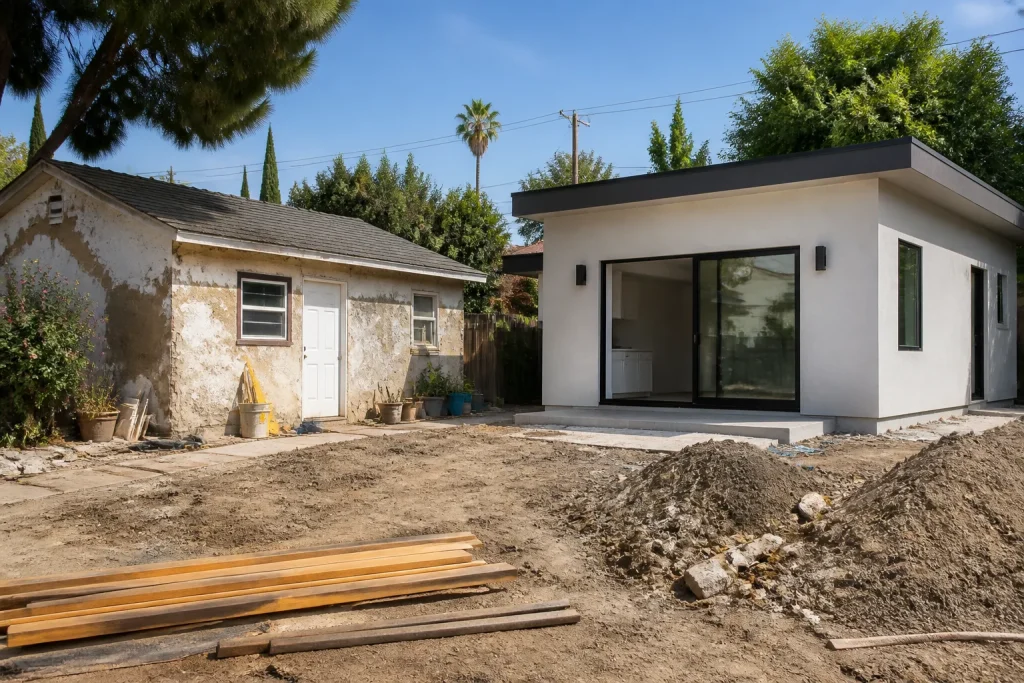
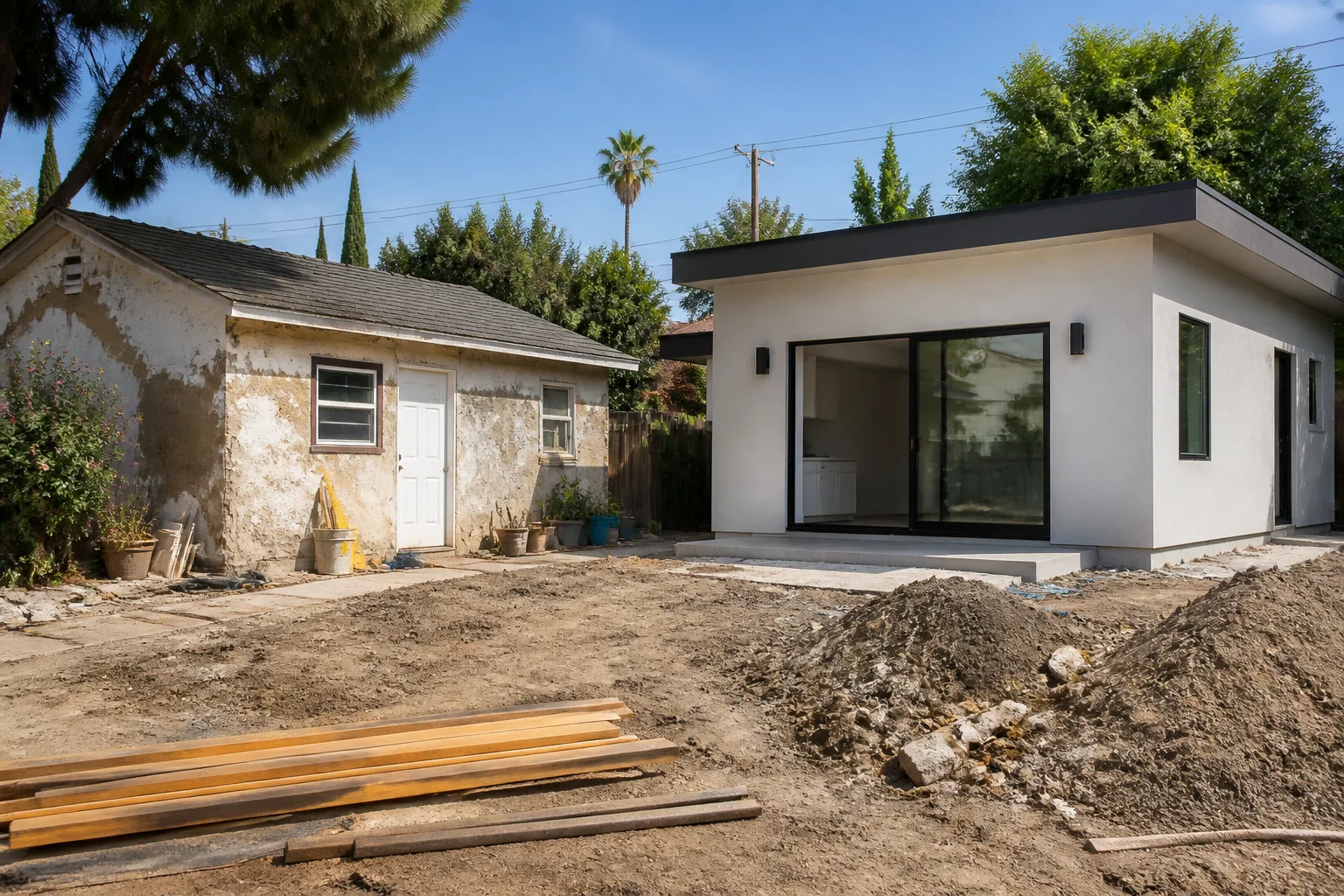
ADU Builders: Repair or Replace? How Los Angeles Homeowners Decide
If your existing ADU has a failing roof, cracked foundation, or framing that’s seen better days, the repair-or-replace question in Los Angeles usually comes down to one number: 50%. Under the LA Department of Building and Safety’s substantial improvement threshold, repairing more than half of the structure’s assessed value or structural components within 12 months legally reclassifies the job as new construction. That means new permit fees, current setback compliance, and utility reconnection costs. Here’s how to think through it before you sign anything.
And if you’d rather skip the reading and talk to someone who does this every week, call (361) 315-4177 and we’ll walk you through it free.
The 50% Rule: What Actually Triggers a Rebuild in Los Angeles
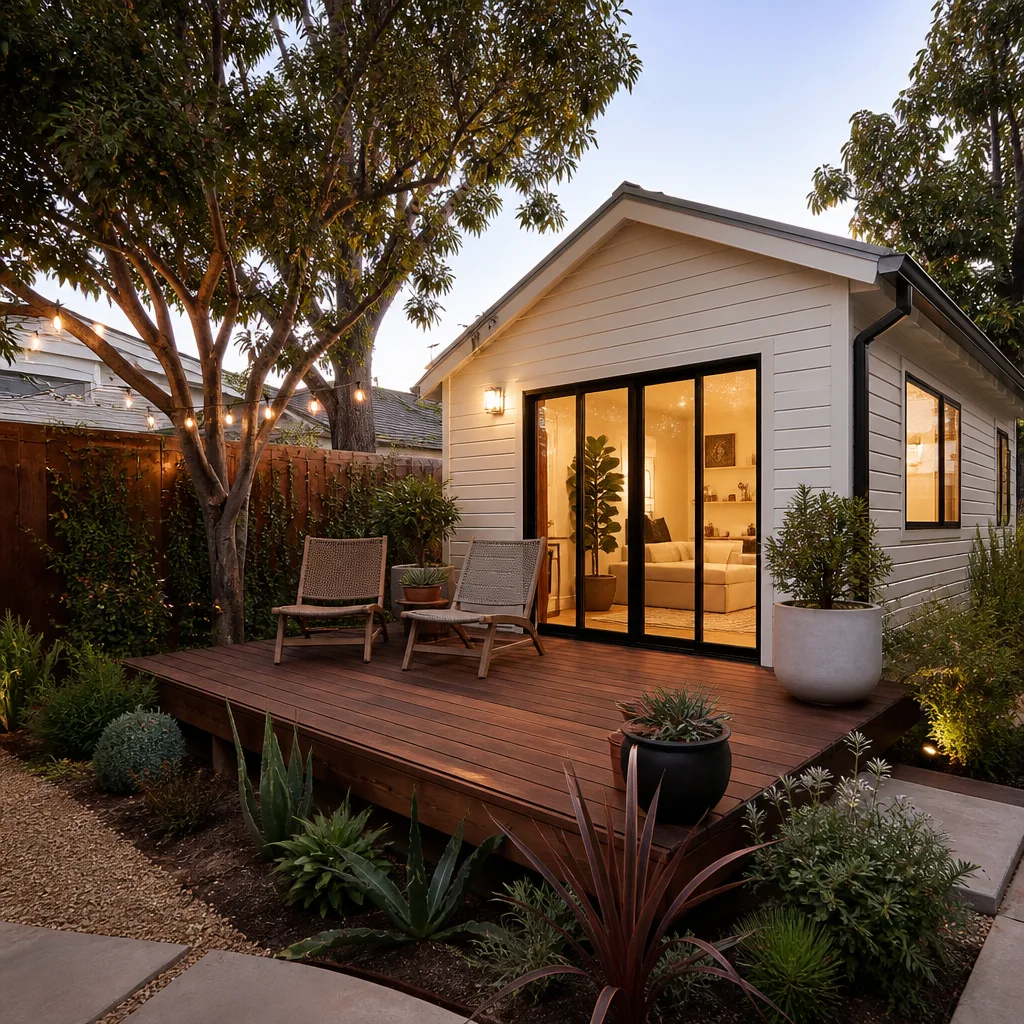
Los Angeles housing stock skews old. A lot of the ADUs we look at were built between 1950 and 1980, back when they might have been called granny flats or simply unpermitted back houses. The city’s Los Angeles Department of Building and Safety doesn’t care what you call it today. It cares about what the permit paperwork says, and whether the repair scope crosses the substantial improvement line.
Here’s the practical version of the rule. If the cost of repairs over any 12-month period exceeds 50% of the building’s pre-damage assessed value, the city treats it as new construction. Same goes for replacing 50% or more of the structural framing, load-bearing walls, or foundation. Once you’re on that side of the line, Los Angeles requires compliance with current codes: setbacks, height limits, parking, fire sprinklers in some cases, and sometimes utility upgrades.
That last point catches people off guard. You can plan to spend $70,000 repairing a sagging roof and cracked footer, then find out the city now requires a new water service line and seismic retrofit because the building crossed into rebuild territory. The repair bid becomes a rebuild bid before you’ve filed anything.
We tell Los Angeles homeowners to get a written structural assessment before deciding. Not a verbal opinion from a contractor who hasn’t seen the foundation. A written report from a licensed structural engineer that lists what is failing, what is fine, and what percentage of the structure is involved. That report is the document you’ll use to determine if the 50% line is anywhere near. It also stops a builder from telling you it’s “basically a rebuild” when it’s actually a $30,000 repair.
What a Written Structural Assessment Should Include
Any engineer qualified to write this report in Los Angeles should be licensed in California and familiar with LA’s local amendments. The report should run 8 to 15 pages and cover these items, at minimum:
- A condition inventory of the foundation, floor framing, wall framing, roof structure, and any retaining walls within 10 feet of the structure.
- A specific list of deficient components, with photographs and measurements.
- The engineer’s estimate of what percentage of the structural system requires repair or replacement.
- A written statement of whether the repair, as described, crosses the substantial improvement threshold under current Los Angeles code.
- Seismic retrofit requirements specific to your ADU’s age and construction type.
- Any observed unpermitted work from previous owners, because that affects the permit path if you choose to permit the repair.
Expect to pay $2,500 to $6,000 for a thorough assessment in Los Angeles. That’s real money, but it’s the difference between making a decision with a map versus driving blind. A homeowner in Woodland Hills last year paid $4,800 for an assessment that showed the building needed $38,000 in foundation work, not the $110,000 rebuild a contractor had quoted. The report paid for itself before lunch.
When Repair Is the Right Financial Call
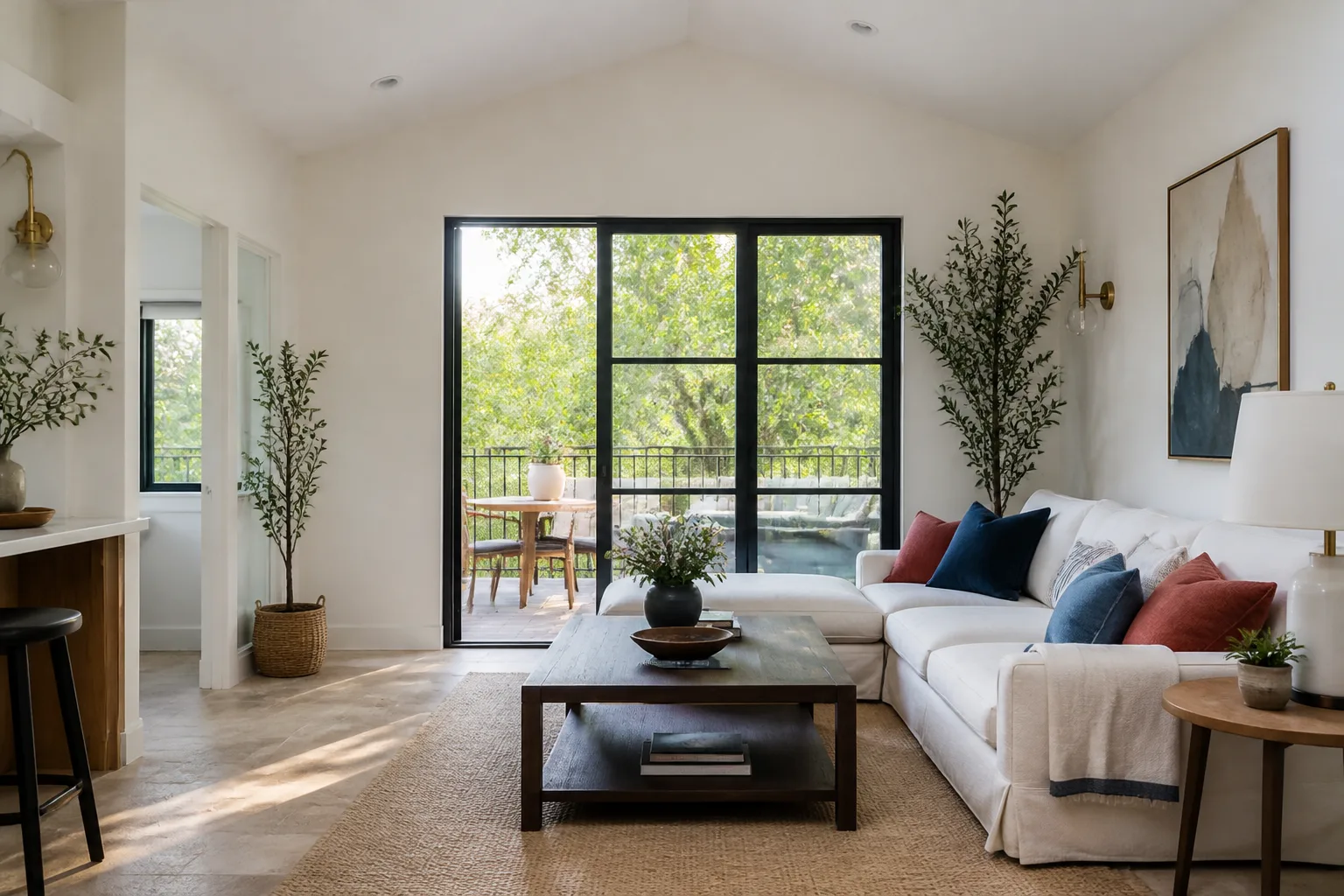
Repair wins when three conditions hold. First, the damage is isolated: one section of roof, one footing, one bearing wall. Second, the building’s guts are still sound: floor framing that hasn’t been chewed by termites, exterior walls that aren’t leaning, and a foundation that hasn’t settled more than an inch or two. Third, the ADU is already in a good spot on the lot.
In those cases, a repair keeps you out of current-code compliance for the unaffected parts of the structure. Los Angeles allows repair of existing non-conforming conditions, as long as the scope stays under the threshold. You do not have to make the whole building current if you’re replacing a rotted header or sistering floor joists.
Repair also preserves rental continuity. A tenant in place can often stay during a roof repair. A rebuild means vacancy, and in Los Angeles that vacancy runs six to fourteen months depending on permitting and inspection backlog. If the ADU rents for $2,400 a month, a rebuild costs you $14,000 to $33,000 in lost rent before you’ve swung a hammer. Repair keeps the checks coming.
One more repair advantage that doesn’t show up in any spreadsheet: you keep grandfathering. The building’s existing footprint, setbacks, and height are protected if you stay under the line. Once you cross into new construction, the city measures your lot against today’s rules. That rear setback that was legal in 1962 might not be legal now, and the variance process in Los Angeles adds months and money.
When Replacement Is Cheaper than Repair, Long-Term
Replacement starts to win when the repair estimate climbs past 60% of the replacement cost, or when the building has systemic problems: foundation settlement in multiple corners, widespread termite damage through the framing, or roof leaks that have been running into the walls for years. Repairing a building with three failing systems is like patching a tire with two nails and a slow leak in the sidewall. You’ll be back every 18 months.
There’s also a strong argument for replacement when the ADU is too small, too dark, or positioned badly on the lot. Los Angeles zoning changed under SB 9 and related state ADU laws. A replacement ADU may now be allowed to be larger than the original, or built closer to the rear property line than what the 1970s structure sits at. If you’re spending $90,000 to repair anyway, and the replacement allows a 1,200-square-foot ADU where an 800-square-foot one stood, the dollars per square foot of usable living space start to favor the rebuild.
New construction in Los Angeles also means current energy code, which matters if you’re paying the utility bill or marketing the unit to tenants. A new ADU built to Title 24 standards costs less to heat and cool than a 1970s building with single-pane windows and no wall insulation. That gap shows up every month on the electric bill, and it’s a real number.
Finally, replacement resets the maintenance clock. A new foundation, new roof, new plumbing, and new electrical means the next major capital expense is 20 to 30 years out. Repair buys you five to ten, and sometimes not even that.
Comparing the Two Bids: Total Project Cost, Not Just Construction Cost
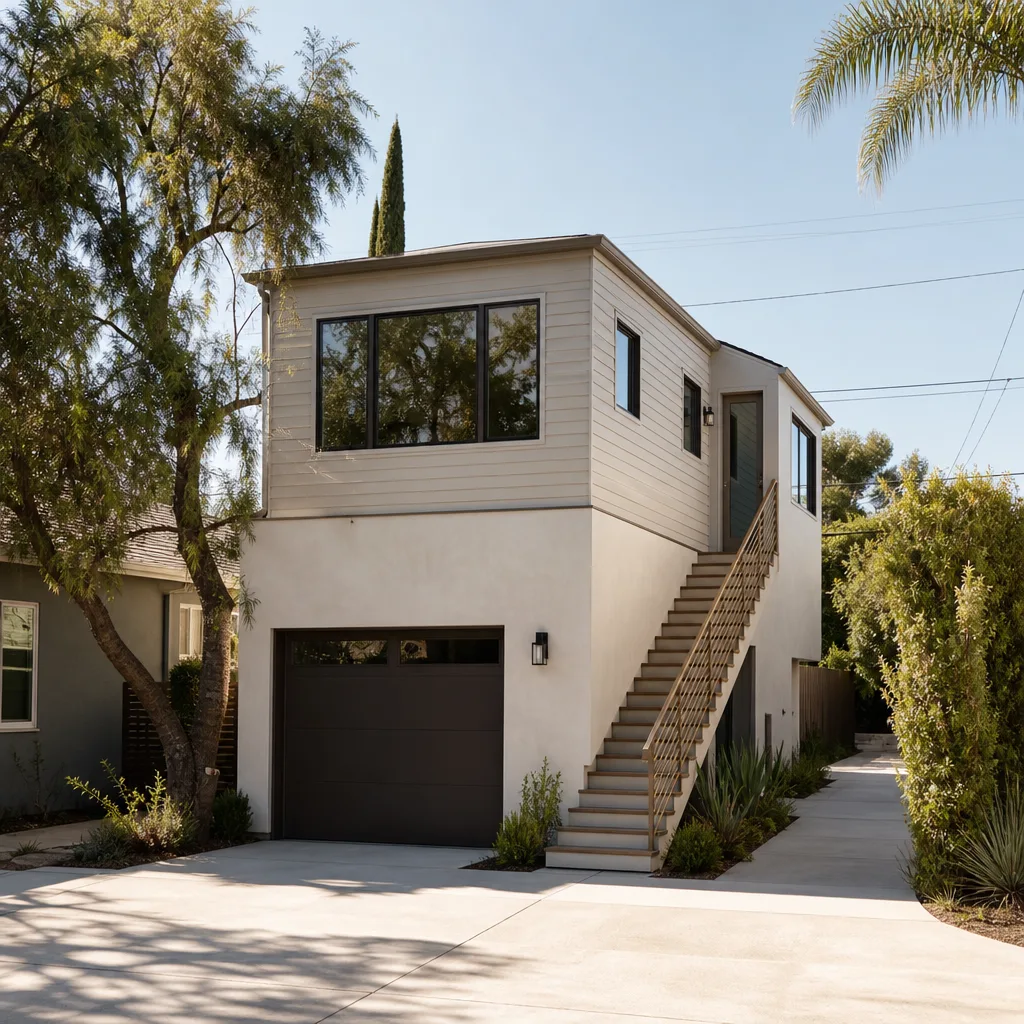
This is where we see Los Angeles homeowners get burned most often. A contractor hands them a $45,000 repair bid and a $95,000 replacement bid, and the repair looks like a bargain. But the two numbers aren’t measuring the same thing.
A written bid for the repair path should include: the structural assessment cost, permit fees, any required seismic retrofit, and a contingency line for the surprises that show up once walls are open. A written bid for replacement should include: demolition and haul-off, civil engineering, plans, permit fees, utility connections, and landscaping repair where the old structure sat.
Here’s what a real comparison looks like in Los Angeles for a 900-square-foot ADU:
- Repair path (foundation + roof + one wall): $60,000 to $85,000, 2 to 4 months, tenant can usually stay.
- Replacement path (same footprint, conventional build): $180,000 to $260,000, 8 to 14 months, vacant the whole time, plus lost rent of $15,000 to $30,000.
- Replacement path (prefab platform, e.g. Abodu, Cover, or Dvele): $160,000 to $240,000 depending on site work and finishing, typically 5 to 8 months from permit to move-in.
Those are real ranges we’ve seen in Los Angeles, not catalog numbers. Site conditions move them. A flat, accessible lot in the Valley builds cheaper than a hillside lot with no crane access in Echo Park.
If you’d rather not do this math alone, we’re happy to help. Our related services in Los Angeles are here: ADU Builders in Los Angeles, plus Garage Conversion Contractor in Los Angeles and Room Addition Contractor in Los Angeles.
SB 9 and Zoning Changes That Shift the Replace Decision
Senate Bill 9 took effect in 2022 and changed the math for a lot of Los Angeles lot owners. The law allows lot splits in single-family zones and clears some local hurdles that used to block replacement ADUs. For an existing ADU that sits too close to a rear or side property line, a replacement under current state law may be buildable where the old one would be denied.
That matters because the repair path requires keeping the footprint. If your 1970s ADU is 3 feet off the rear property line and is falling apart, a repair keeps it 3 feet off that line. A replacement under SB 9 may allow a 4-foot setback, or may trigger the state’s ADU allowance that overrides local setback rules in many cases. The replacement can be placed better on the lot, oriented for light, and sized for higher rent.
This is where the 50% rule intersects with opportunity. Some homeowners discover that their old ADU, if pushed across the rebuild line, could become a property asset worth $150,000 more in appraised value because of the larger buildable envelope. That’s the kind of information that flips a repair decision into a replace decision overnight.
When to Call a Professional
Call a builder or structural engineer when any of these are true: you can see cracks in the foundation wider than a quarter inch, doors stick seasonally and the sticking gets worse year over year, the floor slopes more than an inch over 10 feet, or the roof has leaked more than twice in the last five years. Those are signs of structural movement or water that has already entered the walls. A visual check won’t tell you how deep it goes.
We also tell people: if a contractor gives you a repair quote without an engineer’s report for structural work above $20,000, get a second opinion. In Los Angeles, structural work needs a permit, and a permit needs a structural stamp. A builder who skips that step is leaving you with a building that cannot be sold or refinanced without legal headache later.
The Bottom Line
The repair-or-replace decision for a Los Angeles ADU starts with the 50% substantial improvement rule. If repairs stay under half the building’s assessed value and structural components, you can repair and keep your existing non-conforming status. If the scope crosses the line, the city treats it as new construction, and you should compare that path honestly against the advantages of building new, especially with the flexibility SB 9 now offers. Get a written structural assessment first. Then get written bids for both paths that include every cost, not just the construction line. The decision will make itself from the numbers.
If you’re in Los Angeles and want help working through this, Fielding ADU Builders home offers free estimates. We’ll do the math with you and explain the permit path without charge. Call (361) 315-4177.
Frequently Asked Questions
The city determines this based on the repair cost compared to the building’s assessed value before the damage occurred, or based on the percentage of structural components being replaced. A licensed structural engineer can write the report that estimates where your project falls. You can also call (361) 315-4177 and ask us to come take a look. There’s no charge for the first visit.
Often yes, if the work is isolated to one system like the roof or a single foundation corner. Full structural rebuilds mean vacancy across most of the build. Los Angeles rent prices make that lost income a meaningful part of the decision. The Garrison Standard working approach is that every Fielding ADU Builders project gets a written price before any work starts, so you can plan the budget with real numbers, not estimates that move mid-job.
Every line item, not a lump sum. Material allowances by brand and grade. Permit fees broken out by line item. Contingency as a stated percentage, typically 5 to 10 percent. A timeline with milestones. And a written guarantee: The Garrison Standard covers workmanship defects for 365 days, and if something fails, we come back and make it right at no charge.
Yes. We’re fluent in the prefab platforms homeowners often research, including Abodu, Cover, Dvele, and Mighty Buildings, plus conventional builds using James Hardie siding. The right platform depends on your lot access, budget, and the size you can build under current Los Angeles zoning. A written bid from us includes the platform choice and why we recommend it for your specific site.
Written by the team at Fielding ADU Builders.
Need ADU Help?
Call Fielding ADU Builders - licensed & insured, here with fast after-hours help in Los Angeles.
(361) 315-4177