Last updated October 9, 2026
ADU Cost Breakdown: The Los Angeles Homeowner’s Reference for 2026
The $200-per-square-foot figure quoted on most ADU websites covers framing and finishes. It does not cover the $18,000 to $35,000 in utility lateral upgrades, soils reports, or school fees that Los Angeles requires before a foundation is poured. This guide exists because you have probably already discovered that the first number a contractor gives you and the number on the final invoice rarely match. By the time you finish reading, you will know every line item that belongs on a Los Angeles ADU budget, which ones are negotiable, which ones are not, and where the hidden costs actually come from.
Quick Answer
An ADU in Los Angeles costs $150,000 to $400,000+ depending on size, site conditions, and build method. A garage conversion that keeps the existing slab, roof, and walls can start around $120,000, while a detached 800-square-foot new build typically lands between $250,000 and $350,000 before landscaping. The spread is real, and it is driven by utility upgrades, permit fees, and site work, not contractor markup.
Table of Contents
- The Line-Item Budget: Where Every Dollar Actually Goes
- Garage Conversion vs. Detached New Build: The Real Cost Difference
- Utility Upgrades: The Cost Nobody Quotes Over the Phone
- Permits, School Fees, and LA Department of Water and Power Charges
- Fixed-Price Contract vs. Cost-Plus: What Each One Means for Your Exposure
- Financing Options That Actually Work for LA ADUs
- Common Mistakes to Avoid
- When to Call a Professional
- Frequently Asked Questions
The Line-Item Budget: Where Every Dollar Actually Goes
A well-built detached ADU in Los Angeles is not a single number. It is a stack of smaller budgets that each respond to different forces: city code, soil type, utility district, and your own finish selections. Here is the line-item breakdown we use when we walk a Los Angeles homeowner through a written price.
| Line Item | Typical Range (Detached ADU) | Typical Range (Garage Conversion) |
|---|---|---|
| Design & engineering (architect, structural, Title 24) | $8,000 – $18,000 | $5,000 – $12,000 |
| Soils report & grading plan | $2,500 – $5,000 | Often not required |
| Permit fees (city + LA Department of Building and Safety) | $3,000 – $8,000 | $2,000 – $5,000 |
| School impact fees (LAUSD) | $4 – $12 per sq ft, often waived under 750 sq ft | Often waived |
| LADWP utility connections & meter work | $5,000 – $20,000 | $1,000 – $6,000 |
| Site prep (demolition, tree removal, grading) | $8,000 – $25,000 | $2,000 – $8,000 |
| Foundation & slab | $15,000 – $35,000 | $0 – $8,000 (slab repair only) |
| Framing, roofing, exterior (James Hardie or stucco) | $35,000 – $70,000 | $8,000 – $20,000 |
| Rough MEP (plumbing, electrical, mechanical) | $18,000 – $40,000 | $10,000 – $25,000 |
| Insulation, drywall, paint, trim | $12,000 – $22,000 | $8,000 – $16,000 |
| Kitchen & bath finishes (fixtures, tile, counters) | $20,000 – $50,000 | $15,000 – $40,000 |
| Flooring throughout | $4,000 – $10,000 | $3,000 – $8,000 |
| Solar (if required by Title 24 for new detached) | $6,000 – $15,000 | Not usually required |
| Landscaping restoration & drainage | $4,000 – $12,000 | $2,000 – $6,000 |
| Subtotal | $140,500 – $330,000 | $56,000 – $154,000 |
That subtotal does not include contingency. We recommend Los Angeles homeowners hold a 10 to 15 percent reserve for what we call discovery items: a rotted rim joist behind the garage drywall, a sewer lateral that fails the camera test, or an electrical panel from 1972 that cannot legally carry the new load. The written price we give before work starts includes what we can see and measure. A fixed-price contract means the line items we both signed stay fixed. Discovery items get their own change order, in writing, before any work proceeds.
The table above is why “cost per square foot” is a weak way to price a Los Angeles ADU. A 600-square-foot ADU with a kitchen and bath carries roughly the same utility and permit burden as a 900-square-foot one. The square-footage math breaks down fast. We would rather put a line-item price in writing and let the numbers stand on their own.
Garage Conversion vs. Detached New Build: The Real Cost Difference
A garage conversion in Los Angeles costs 30 to 50 percent less than a detached ADU of the same square footage because four of the most expensive scopes are already done: the slab, the framing, the roof, and one wall of the building envelope. When those four items total $60,000 to $110,000 on a new build, the savings are structural, not promotional. If you are weighing a conversion against a new build, the math usually favors the garage. But three conditions can erase that advantage.
First, if the existing garage slab is out of level by more than two inches or lacks a proper foundation perimeter, you are not converting, you are rebuilding. In older Los Angeles neighborhoods like West Adams, Leimert Park, and parts of the Valley, garage slabs from the 1940s and 1950s were poured as parking pads with no footings. The city will not issue a permit for dwelling use on a slab that does not meet current code. Second, if the garage has significant termite damage or water intrusion through the roof, the repair cost can approach the cost of new framing. Third, if your garage sits in the front setback or blocks required parking, the city may require a replacement parking space or a setback variance, which is the city’s written permission to build closer to the property line than the standard rule allows. A variance can add $4,000 to $10,000 in application costs and months of wait time. None of these conditions show up in a website cost estimate. They show up in a soils report and a site visit.
One practical note: the garage conversion path in Los Angeles often moves faster through plan check because the structure already exists. That speed has real value if you are paying carrying costs on the property or renting the main house while the work proceeds.
Utility Upgrades: The Cost Nobody Quotes Over the Phone
Here is a number most ADU cost guides will not give you: the electrical panel upgrade alone in Los Angeles runs $3,500 to $8,000 depending on whether you need a 125-amp or 200-amp panel and whether the service drop from the pole needs new conduit. The sewer lateral, which is the pipe running from your house to the city main under the street, can cost $8,000 to $20,000 if it is old cast iron or clay and fails the camera inspection the city requires before signing off. A new gas meter from SoCalGas, if your ADU adds a second kitchen or laundry with gas appliances, can add $2,000 to $5,000 in meter and line work.
These costs are not optional extras. They are triggered by Los Angeles code and utility district rules. The city requires that any new dwelling unit have its own electrical load calculation, and if your existing 100-amp panel cannot carry the ADU, the upgrade is mandatory before the final inspection. The same logic applies to water: some Los Angeles neighborhoods require a new water lateral or a backflow preventer, especially on hillside lots in Silver Lake, Echo Park, or Mount Washington where pressure varies by elevation.
Why are these numbers site-specific and not estimable from a website? Because the condition of your underground lines, the distance from your panel to the pole, and the soil type in your yard are physical facts that exist only on your property. A contractor who quotes you a finished ADU price without looking at your sewer lateral is guessing. That is how change orders happen. Our written price always includes a utility-scope line after a site walk, because we would rather give you a real number that holds than a low number that moves.
One more item Los Angeles homeowners miss: the DWP connection fee for a new separate meter runs $3,000 to $10,000 depending on whether you submeter the ADU or run a new service drop. Submetering is usually cheaper but requires a landlord-owned meter agreement. A solar requirement under California Title 24 applies to most new detached ADUs, and that is another $6,000 to $15,000 depending on system size and roof orientation.
Permits, School Fees, and LA Department of Water and Power Charges
Los Angeles has some of the most ADU-friendly state-level rules in the country, but local fees still stack up, as explained in our ADU Warning Signs: A Los Angeles Homeowner’s Reference Guide. The city permit fee for an ADU typically runs $3,000 to $8,000 depending on valuation and plan check complexity. The Los Angeles Department of Building and Safety (LADBS) charges plan check and inspection fees separately, so do not assume the permit number you see on a city fee schedule is the whole picture.
School impact fees are the most misunderstood line item. LAUSD charges a fee per square foot on new residential construction, but California state law currently exempts ADUs under 750 square feet. Most Los Angeles homeowners building a 500 to 749 square foot ADU pay zero school fees. Over 750 square feet, expect $4 to $12 per square foot depending on the district’s current rate and your project type. A 900-square-foot detached ADU in Los Angeles can carry a school fee of $3,600 to $10,800 that no contractor’s website mentions.
Here is a step-by-step look at what the Los Angeles permit path actually looks like for a standard detached ADU:
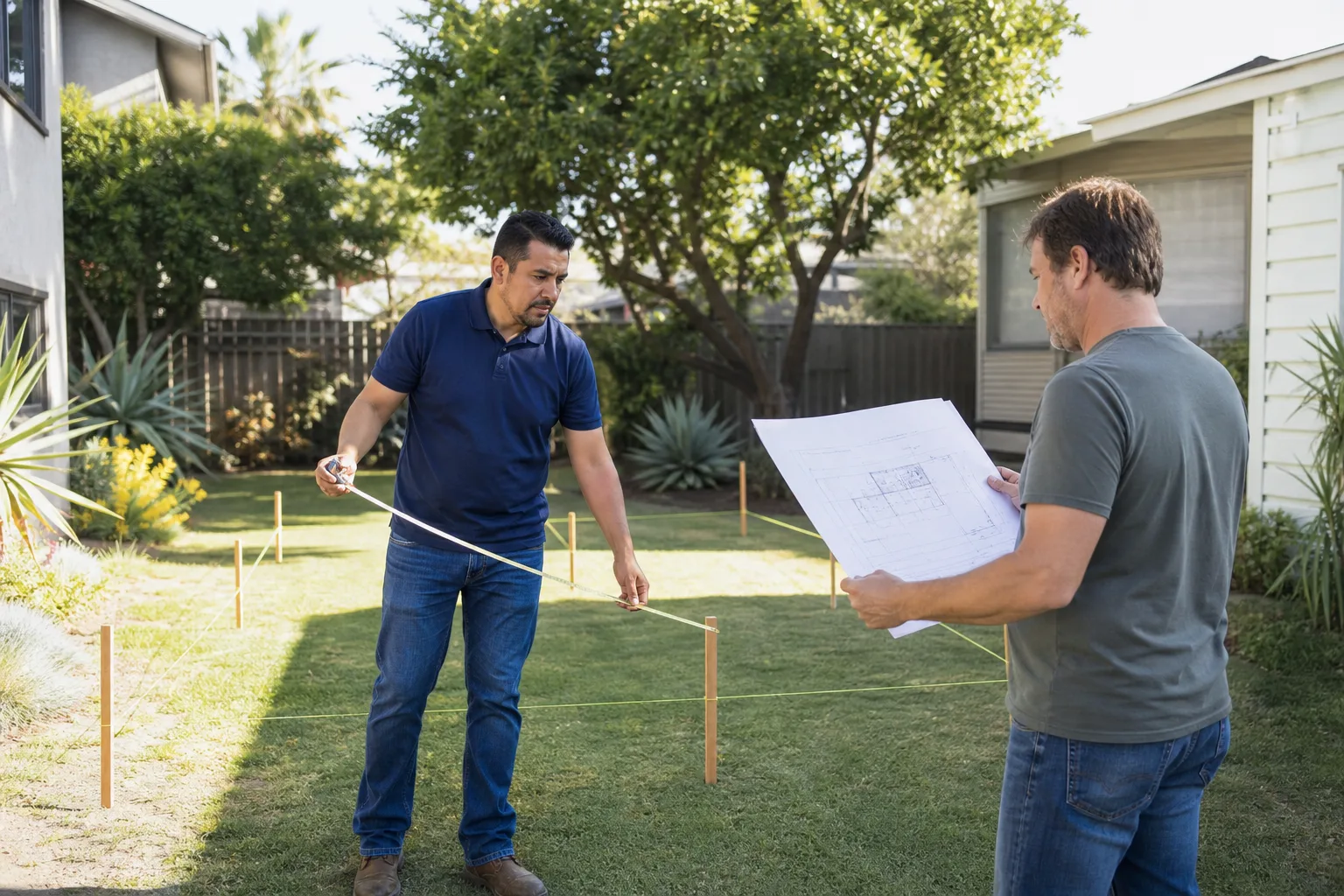
- Site assessment and feasibility check. Zoning verification with the city, setback measurement, and a check of any historic overlay (HPOZ) rules that apply to neighborhoods like Angelino Heights or Hancock Park.
- Soils report and grading plan, if required. Most hillside and some flat-lot ADUs in Los Angeles need this before structural drawings are stamped.
- Architectural and structural drawings, including Title 24 energy calculations. Plan check turnaround at LADBS currently runs 4 to 12 weeks depending on workload.
- Utility applications filed with LADWP and SoCalGas. These run parallel to plan check, not after it, to avoid a utility delay at the back end.
- Permit issuance and construction start.
- Rough inspections (foundation, framing, MEP) and a final inspection that includes the utility sign-offs.
- Certificate of occupancy from LADBS, which is what makes the ADU legal to rent or list as living space.
If any of this sounds like a lot of standing in line, that is because it is. A contractor who handles permits by the book, pulls them under their own license, and walks the inspections means you are not the one chasing plan check comments. We do not hand you a permit application and wave. The permit, the inspections, and the final sign-off are part of the job.
Fixed-Price Contract vs. Cost-Plus: What Each One Means for Your Exposure
A fixed-price contract says: the number you approve on day one is the number on the final invoice, unless you change the scope. A cost-plus contract says: you pay the actual cost of labor and materials plus a percentage markup, whatever that total turns out to be. Both are legal, and both are common in Los Angeles. But they expose you to very different financial risk.
Before we started Fielding ADU Builders, most of the homeowners who came to us after a bad experience had signed cost-plus contracts without understanding what they were signing. They approved a bid of $220,000 and finished at $310,000, not because anyone was dishonest, but because the contract never capped their exposure. The lumber price moved, the tile selection cost more than the allowance, the framing crew hit unexpected rot. Each surprise became their bill. That is how cost-plus works. It transfers risk from the contractor to you.
A fixed-price written contract works differently. The contractor absorbs the risk of their own estimating errors. The price goes in writing before any work starts, and the number you approve is the number on the final invoice. The Garrison Code, which is how we operate at Fielding ADU Builders, puts it plainly: show up in the window, price in writing, by the book, leave it clean, stand behind it for a year. That last line is the guarantee, and it is written, not implied. The Garrison Standard covers workmanship defects for 365 days. If something fails inside that year, we come back and make it right at no charge.
Here is the practical difference: on a fixed-price contract, a change order is an exception, not the rule. On cost-plus, every week is a new total. For a Los Angeles homeowner writing a five-figure check, the fixed price is not an amenity. It is the difference between a budget and a guess.
If a contractor will not put a fixed price in writing before work starts, ask why. The answer will tell you more than the bid.
Financing Options That Actually Work for LA ADUs
Los Angeles homeowners finance ADUs through four main routes, and each one carries a specific limitation that matters as much as the interest rate.
- ADU-specific construction loans. Lenders like RenoFi, Figure, and some credit unions underwrite against the future value of the property with the ADU complete. These loans fund draws during construction and convert to permanent financing after the certificate of occupancy. The catch: they typically require a licensed general contractor and a fixed-price contract. A cost-plus bid will not pass underwriting.
- HELOC or home equity loan. The cheapest money if you have equity, but the draw structure assumes you can front costs and reimburse yourself. HELOCs also max out against current appraised value, which may not cover a $300,000 detached ADU on a home with $200,000 in equity. In Los Angeles, where home values are high, this route works for homeowners who bought years ago.
- Fannie Mae HomeStyle Renovation loan. A single mortgage that rolls the ADU cost into the purchase or refinance. The interest rate is better than a construction loan, but the paperwork is heavier, and the lender requires the work to be done by a licensed contractor with documented draws. HomeStyle does not love owner-builder projects.
- Cash-out refinance. Works well in Los Angeles where appreciation has been strong, but the rate on the entire first mortgage moves, not just the ADU portion. Run the math against a construction loan before choosing this.
What none of these products cover well is the gap between the line-item budget and the discovery items. A sewer lateral replacement, a panel upgrade, a variance application, a soils report that comes back with expansive soil requiring engineered fill. Those costs are real, and they arrive early, before the foundation is poured. That is the strongest argument for a written, fixed-price contract that already includes the utility scope and the permit line. The bank will fund what the contract says. The contract needs to say the truth.
One financing note specific to Los Angeles: the city’s ADU accelerator program and some state-level grants exist, but they are narrow and competitive. Do not build a financing plan around a grant you have not been awarded. Build it around cash or approved credit, and treat any grant as a bonus.
Common Mistakes to Avoid
- Pricing by square foot without a line-item budget. The $200-per-square-foot figure omits the utility lateral work, school fees, and soils costs that Los Angeles triggers. Ask for the line items, not the average.
- Ignoring the sewer lateral until the final inspection. The city will not sign off until the lateral passes camera inspection. A failed lateral at the end of the project is a $8,000 to $20,000 surprise and a delayed move-in.
- Signing a cost-plus contract without a cap. If the contractor will not cap their exposure contractually, yours is uncapped. In Los Angeles, where change orders on discovery items are common, a cap is the single most important clause.
- Assuming the garage slab is usable. Pre-1950 slabs in Los Angeles were often poured as parking pads without footings. A soils report or a simple level check tells you whether you are converting or rebuilding.
- Skipping the Title 24 solar calculation. Most new detached ADUs in Los Angeles require solar. If it is not in the budget, it becomes a change order at rough-in.
- Overlooking HPOZ rules. Historic Preservation Overlay Zones in neighborhoods like Angelino Heights, Highland Park, and parts of South LA restrict exterior changes and sometimes ADU placement. A zoning check before design saves months.
- Not holding a contingency reserve. Los Angeles lots surprise you: old oil wells in the basin, expansive soil in the hills, undocumented additions that complicate the plan. Hold 10 to 15 percent and you will not be financing the surprise on a credit card.
When to Call a Professional
You should call a professional when the cost of guessing exceeds the cost of the estimate. If you have a garage you think could convert, a backyard with utility access questions, or a lot in an HPOZ or hillside zone, a written price from someone who has walked the site will tell you more in an hour than a month of online estimates. If you have received a bid that seems too low, run it past a second set of eyes. The low bid in Los Angeles is usually a bid that omits the sewer lateral, the panel upgrade, or the school fee, and intends to discover those items later at your expense. Fielding ADU Builders offers free estimates in Los Angeles – call (361) 315-4177 and we will walk the site and put a written line-item price in front of you. No pressure, no discovery games. The number goes in writing before any work starts.
Frequently Asked Questions
A detached ADU in Los Angeles costs $150,000 to $400,000+, while a garage conversion typically runs $120,000 to $250,000 depending on scope, site conditions, and finish level. The line-item differences are driven by utility upgrades, permit fees, and site work, not markups. Call (361) 315-4177 for a written line-item price on your specific property.
Los Angeles ADU bids vary because site conditions vary: sewer lateral condition, electrical panel capacity, soil type, HPOZ restrictions, and utility district requirements all move the number by tens of thousands of dollars before finishes are even discussed. A bid that omits these items will be lower and less honest. Ask for the line items that back up the total.
Yes, a garage conversion in Los Angeles runs 30 to 50 percent less than a detached new build because the slab, framing, and roof often already exist. The savings disappear if the slab lacks footings, the structure has significant damage, or the city requires a setback variance or replacement parking.
Not if you signed a fixed-price written contract, and not unless you change the scope. Discovery items like a failed sewer lateral or undersized panel are written as change orders with their own price approval before work proceeds. A cost-plus contract has no such protection, which is why we write fixed prices before any work starts.
Most hillside lots and many flat lots in Los Angeles require a soils report before structural drawings are stamped. The report runs $2,500 to $5,000 and tells the engineer whether the foundation needs standard footings or engineered fill. Skipping it is not an option the city will allow on a permitted build.
Yes. We pull the permits under our license, handle plan check and inspections, and walk the project through final sign-off and certificate of occupancy. The permit, inspections, and final paperwork are part of the job, not an extra service. Call (361) 315-4177 and we will confirm what your specific lot requires.
The Bottom Line
A Los Angeles ADU is a real investment, and the honest cost is higher than most websites admit because the honest cost includes utility work, permit fees, and site conditions that no online calculator can see-explore more guides & resources for deeper cost breakdowns. A garage conversion is the most cost-effective path when the structure cooperates. A fixed-price written contract is the single best protection you can buy against a number that moves. And a one-year written guarantee, like The Garrison Standard we build under, means the work is not done when the invoice is paid. It is done when the year runs out and everything still works. That is the standard, and it is in writing.
Written by Reed Calloway, Owner at Fielding ADU Builders, serving Los Angeles since 2006.