Last updated October 9, 2026
DIY vs Professional ADU Builders: What’s Safe to Do Yourself
California law allows an unlicensed homeowner to act as their own general contractor on an ADU, pull permits, and hire subcontractors directly. What the law doesn’t tell you is that an owner-built ADU in Los Angeles carries a 10-year resale disclosure requirement that makes lenders pause and buyers negotiate harder. By the time you factor in the trades you cannot legally perform, the inspection failures that reset your schedule, and the insurance gaps you own as an unlicensed builder, the savings often shrink to the finish work only. This guide walks through exactly what you can do, what you shouldn’t, and where the money actually goes. For more guides & resources, visit our blog.
Quick Answer
You can legally build your own ADU in Los Angeles as an owner-builder, but only if you perform no work requiring a C-license yourself and you disclose owner-builder status at resale for 10 years under California Business and Professions Code 7044. The work genuinely safe for a competent DIYer is finish work: paint, tile, trim, flooring, and owner-supplied fixtures, after rough inspections pass. Everything upstream – electrical, plumbing, HVAC, framing – should be left to licensed trades because that’s where failed inspections, rework, and liability concentrate.
Table of Contents
- What California Law Actually Allows an Owner-Builder to Do
- The Owner-Builder Disclosure Statute and What It Means at Resale
- Work That’s Genuinely Safe for a Competent DIYer
- Where DIY Costs More Than It Saves
- The Liability Exposure of Acting as Your Own General Contractor
- The Permit and Inspection Sequence No One Walks You Through
- Common Mistakes to Avoid
- When to Call a Professional
What California Law Actually Allows an Owner-Builder to Do
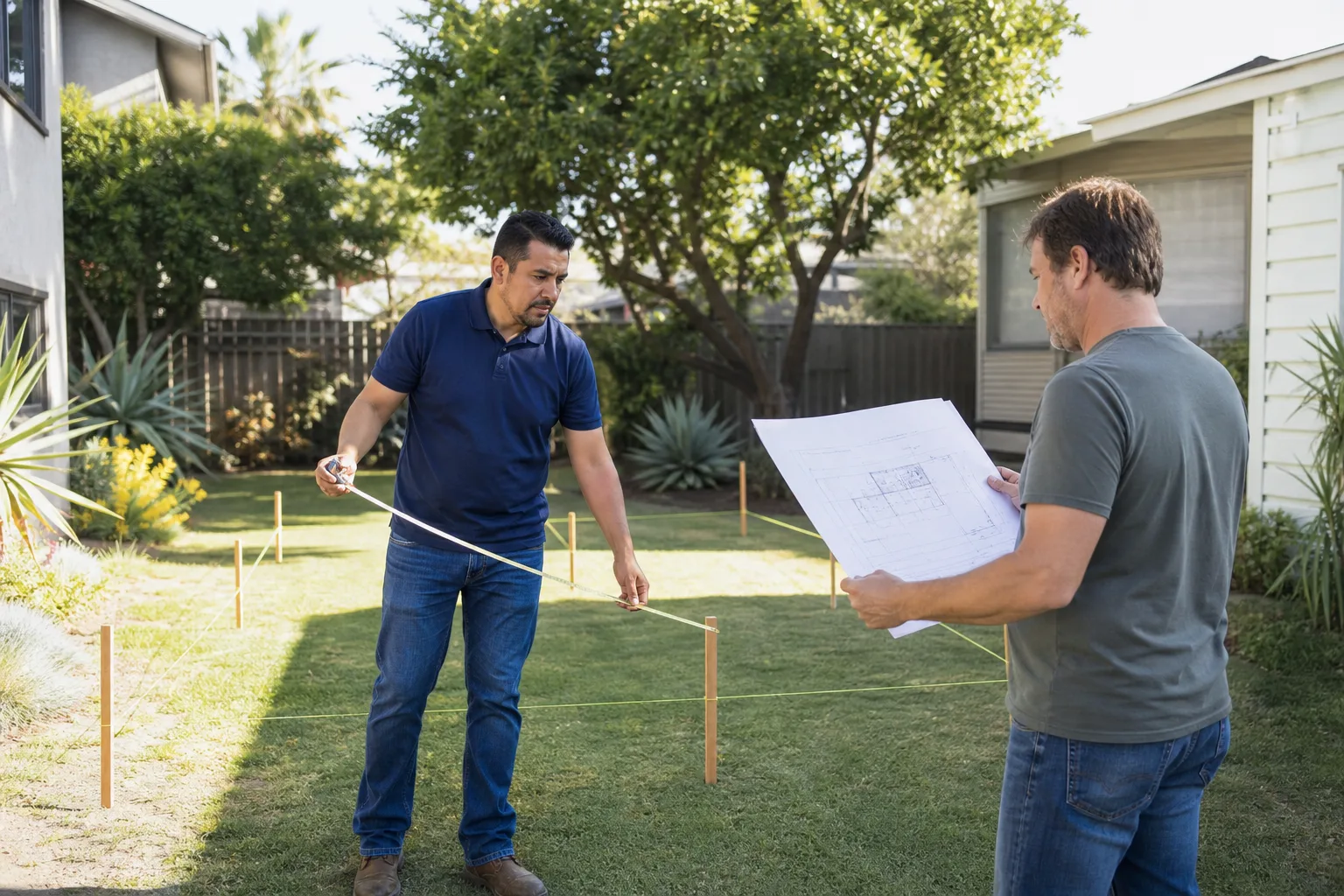
California Business and Professions Code Section 7044 exempts the owner of a property from the contractor licensing requirement when the work is on their own residence and they either do it themselves or hire licensed subcontractors directly. That means you, as the homeowner, can pull the building permit for an ADU on your property in Los Angeles without holding a contractor’s license. You can also hire electricians, plumbers, and framers directly, pay them as subcontractors, and manage the schedule. What you cannot do, regardless of owner-builder status, is perform work that requires a specialty license under California law.
Here’s the breakdown, trade by trade:
- Electrical: Any wiring of the ADU panel, branch circuits, or fixtures requires a C-10 electrical contractor license. An owner-builder cannot legally pull Romex, land breakers, or set a subpanel.
- Plumbing: A C-36 licensed plumber must handle supply lines, DWV (drain-waste-vent) piping, gas lines, and water heater connections. You cannot sweat copper or run PEX yourself.
- HVAC: Installing a mini-split, running refrigerant lines, or connecting ductwork requires a C-20 license. You can mount a wall sleeve for a through-the-wall unit only after the mechanical contractor has done the line set.
- Framing: This is where it gets nuanced. Framing is not a separately licensed trade in California, so an owner-builder can technically frame walls. But framing errors are the most common cause of failed structural inspections in Los Angeles, where LADBS inspectors look for hold-down placement, shear nailing schedules, and anchor bolt spacing that match the approved plans. Most homeowners who try this end up paying a framer to tear out and redo the work.
- Roofing: A C-39 roofing license is required for any roofing work over a certain square footage threshold. An owner-builder can do minor patching but not a full ADU roof replacement.
- Painting, tile, flooring, finish carpentry, and landscaping: None of these trades require a specialty license. This is where an owner-builder can work freely without legal exposure.
We’ve seen the pattern repeat across Los Angeles neighborhoods. A homeowner in Reseda pulls an owner-builder permit, frames the walls themselves, and the LADBS structural inspector flags the shear panel nailing pattern on the first visit. The correction costs more than hiring a framer from the start because now the framer is working to remediate, not to build. The legal path is clear, but the practical path is narrower than most people assume.
The Owner-Builder Disclosure Statute and What It Means at Resale
California Business and Professions Code 7044 requires anyone who acts as an owner-builder on a project to disclose that fact in writing to the next buyer if the property is sold within 10 years of completion. The disclosure is a specific form that states the property was constructed or improved under an owner-builder permit and that the seller may not have been a licensed contractor at the time of construction. In Los Angeles, a buyer’s agent sees this disclosure and immediately asks two questions: who actually did the wiring, and what’s the warranty path if something fails.
The practical effect is that an owner-built ADU often appraises lower than a contractor-built one. Lenders scrutinize the permit history more closely. Title companies flag the disclosure. Buyers request inspection contingencies and price reductions. You’re not just saving money on the front end; you may be transferring it to the buyer’s negotiation position on the back end.
The Garris Standard – the operating code behind ADU Builders in Los Angeles – exists precisely because owner-builder resale risk is a known problem in this market. When a licensed contractor builds the ADU, the permits are pulled under the contractor’s license, the disclosure requirement doesn’t apply, and the work carries a written warranty that transfers to the buyer. That’s a structural difference, not a cosmetic one. Reed Calloway has seen buyer’s agents walk away from owner-built ADUs in Echo Park and West Adams specifically because the disclosure created uncertainty the sellers couldn’t resolve.
Work That’s Genuinely Safe for a Competent DIYer
Nobody is saying you should be locked out of your own project. There is real, legitimate work that a capable homeowner can do after the rough inspections pass and the building is weathertight. The key is sequencing: you do your work after the inspector signs off on rough electrical, rough plumbing, and framing, and before or after final inspection depending on the trade. Here’s the sequence that works in Los Angeles:
- After rough inspections pass and drywall is up: You can paint interior walls, hang trim, install baseboards, and lay flooring. None of this requires a license and none of it touches a system an inspector will re-open.
- After the ADU is weathertight: You can install tile in the bathroom and kitchen, hang cabinets if you’re comfortable with layout, and set vanities. These are finish trades with no permitting exposure.
- After final electrical is signed off: You can swap in owner-furnished light fixtures, install door hardware, mount shelves, and hang window treatments. Fixture replacement after inspection is legal and common.
- Exterior work: You can lay pavers for a patio, plant landscaping, build a raised garden bed, and run drip irrigation lines if you connect to an existing hose bib. No license required and LADBS does not inspect landscape work on most ADU permits.
- Final cleanup and punch-list work: You can caulk trim gaps, touch up paint, adjust cabinet doors, and tighten hardware. These are the tasks that make a project feel finished but have zero permitting implications.
The honest truth is that these tasks are maybe 10 to 15 percent of the total project cost on a typical Los Angeles ADU. If you’re budgeting $250,000 for a detached one-bedroom ADU in the San Fernando Valley, the finish work you can safely do yourself is roughly $25,000 to $35,000 in labor value. That’s real money. It is not the same as saving $100,000 by acting as your own general contractor, because you won’t save that. The trades still cost what they cost, and they’ll bill an owner-builder more than they bill a contractor who feeds them steady work.
Where DIY Costs More Than It Saves
The cost equation is simple to state and hard to accept: DIY saves money only where labor is the dominant cost and the work is low-stakes. Framing, electrical rough-in, mechanical rough-in, and plumbing rough-in are not low-stakes. Here’s the math on a typical Los Angeles ADU:
- Electrical rough-in: A C-10 electrician charges $8,000 to $14,000 for a 100-amp subpanel, branch circuits, and fixture rough-in on a one-bedroom ADU. If you do it wrong and the inspector fails it, the electrician charges time and materials to re-pull wires behind closed walls. That’s $2,000 to $5,000 in rework, plus a two-week schedule delay while the city re-inspects.
- Plumbing rough-in: A C-36 plumber charges $6,000 to $12,000 for bathroom and kitchen rough-in. A failed DWV test in Los Angeles, where LADBS requires a water test on waste lines, means cutting out walls to find the leak. Homeowners who try this typically pay double the original plumber’s quote in remediation.
- Framing: The materials for a one-bedroom ADU frame run $15,000 to $25,000. The labor is $20,000 to $35,000. A homeowner who frames wrong and fails a shear inspection pays the framer to rework the wall at $85 to $120 per hour, and the lumber may be partially scrap. The savings disappear in one inspection cycle.
- HVAC rough-in: Mini-split line sets, refrigerant charging, and electrical connections are C-20 work. If you buy a unit online and connect it yourself, the manufacturer warranty is void and LADBS will not sign off on the mechanical final. You’ll pay a contractor to uninstall, redo, and re-commission, at a premium.
Compare that to what you actually save: painting your own ADU interior saves $3,000 to $6,000 in labor. Tiling a bathroom saves $2,500 to $5,000. Laying flooring saves $2,000 to $4,000. Total realistic DIY savings on finish work: $7,500 to $15,000. Total realistic DIY losses from failed inspections on rough trades: $10,000 to $40,000 and three to eight weeks of schedule. The math is not ambiguous.
The Liability Exposure of Acting as Your Own General Contractor
When a licensed general contractor runs your ADU build in Los Angeles, they carry general liability insurance and workers’ compensation coverage for anyone on site. When you act as owner-builder, you become the general contractor in the eyes of the law, and you carry that exposure personally. If a subcontractor you hired directly gets injured on your property, and that subcontractor does not carry their own workers’ comp coverage, you are the employer. Your homeowner’s policy will likely deny the claim because the injury occurred during construction, which is a business activity excluded from most standard HO-3 policies.
Here’s what that looks like in practice. You hire a framer who works under the table to save $8,000. He falls off a ladder while setting a ridge beam and breaks his arm. His medical bills and lost wages are now your exposure. California law makes it exceptionally difficult for an injured worker to waive the right to workers’ comp benefits, even if they signed something. The claim goes to your state fund. The state fund subrogates against you. Your homeowner’s insurance points to the business exclusion. You are now personally liable for six figures.
The fix is simple. Either pay for a workers’ comp policy on yourself as an owner-builder, which costs $4,000 to $8,000 for a project your size, or hire a licensed general contractor who already carries the coverage. A contractor’s workers’ comp policy is a cost you don’t see on a bid breakdown but one that protects you from a claim that can exceed the entire ADU budget. Reed Calloway has watched homeowners in Los Angeles learn this the hard way in neighborhoods from Van Nuys to El Sereno. Fielding ADU Builders carries full workers’ comp coverage on every project, and every crew member is background-checked and uniformed before they step onto a client’s property.
The Permit and Inspection Sequence No One Walks You Through
Los Angeles has its own inspection rhythm. LADBS assigns an inspector based on the project address, and availability is tight in busy building seasons. If you fail an inspection, you don’t just call back the next day. You re-queue, and in some districts that’s a two-week wait. Here’s the standard sequence for a detached ADU in Los Angeles County:
- Foundation inspection: After excavation and before concrete pour. The inspector checks rebar placement, hold-down locations, and formwork against the approved structural plans.
- Underground plumbing and electrical inspection: Trenching, waste line slope, and conduit runs are checked before backfill.
- Framing and rough inspection: The big one. Shear wall nailing, hold-downs, anchor bolts, header size, and fire blocking are all verified. This is the inspection homeowners fail most often when they frame themselves.
- Rough electrical inspection: The C-10 contractor’s work is checked: panel location, wire gauge, junction boxes, and grounding.
- Rough plumbing inspection: Water test on DWV lines, supply line pressure, and venting are verified.
- Rough mechanical inspection: The C-20 contractor’s duct and refrigerant line work is inspected.
- Insulation inspection: R-values are checked against Title 24 energy calculations, which are mandatory in Los Angeles.
- Drywall inspection: Fire-rated drywall and screw spacing are checked before tape and mud.
- Final inspection: Life safety, egress, hardwired smoke and CO detectors, and fixture operation are all verified.
Missing one inspection or failing one resets the timeline. A contractor who builds ADUs in Los Angeles full-time knows what each inspector in each district wants to see. An owner-builder learns it through failure, and each failure costs weeks. That’s the hidden cost of the owner-builder path: not the money, but the calendar. The 10 to 12 months a contractor-managed ADU takes can stretch to 16 or 20 for an owner-builder who is learning the sequence as they go.
Where Prefab and Modular ADU Platforms Change the Equation
If you’re considering owner-builder status because you want to manage costs, there’s a middle path many Los Angeles homeowners miss. Companies like Abodu, Cover, and Dvele build ADUs in a factory and deliver a finished or near-finished structure. The factory handles framing, electrical, plumbing, and mechanical work under a factory license. What’s left on site is foundation, utility connection, and finish touches. That radically shrinks what an owner-builder has to manage.
Abodu, based in the Bay Area and active in Los Angeles, delivers a turnkey ADU in a matter of weeks once permits are in place. Cover builds panelized structures with precision framing that arrives on a truck. Dvele builds high-performance modules with integrated systems. When the factory does the rough work, the on-site trades are reduced to foundation, connection, and sometimes exterior cladding. An owner-builder who would struggle with a six-month stick-framed rough phase can often handle the narrower scope of a prefab site prep, especially with a competent foundation sub and a licensed electrician for the panel tie-in.
The cost on prefab is not dramatically lower than conventional construction in Los Angeles once you add foundation, transportation, crane time, and utility hookups. The schedule is shorter, and the failure points are fewer. For a homeowner weighing DIY, that’s relevant: you’re not choosing between doing everything and doing nothing. You’re choosing how much you manage. Fielding ADU Builders works fluently with Abodu, Cover, Dvele, Mighty Buildings, Boxabl, and Plant Prefab, plus conventional builds using James Hardie siding and Tuff Shed-style structures. The right build method depends on your lot, your budget, and your appetite for managing the process. See DIY vs Professional ADU: The Los Angeles Homeowner’s Decision Guide for a deeper comparison.
Common Mistakes to Avoid
- Pulling an owner-builder permit before you understand the resale disclosure. B&P Code 7044 attaches a 10-year disclosure requirement to your property the moment you act as owner-builder. You cannot undo it by hiring a contractor later; the permit history is public record in Los Angeles.
- Framing your own walls to save money. Failed shear inspections are the single most expensive owner-builder mistake in Los Angeles. A framer charges $85 to $120 an hour to fix what you built, and the inspector re-queues you for weeks.
- Hiring unlicensed subs to save 20 percent. Unlicensed subcontractors in California cannot legally contract for work over $500. If they’re injured on your property, the workers’ comp exposure falls on you personally, and your homeowner’s policy will almost certainly deny the claim.
- Skipping the Title 24 energy calculation. Los Angeles requires Title 24 compliance documents with the permit application. Homeowners who skip this step get their permit application rejected at the counter and lose weeks.
- Installing your own mini-split HVAC system. It voids the manufacturer warranty, fails the mechanical final, and requires a C-20 contractor to uninstall and redo the work at a premium.
- Doing finish work before rough inspections pass. If you hang drywall before the inspector signs off on rough electrical, plumbing, and framing, LADBS will require you to remove the drywall. Paint, tile, and trim come after inspection, never before.
- Assuming homeowner’s insurance covers construction. Standard HO-3 policies exclude construction activities. If someone is hurt on your site, or the half-built structure is damaged, you need a builder’s risk policy or a contractor’s coverage. Owner-builders who skip this are self-insuring a six-figure exposure.
When to Call a Professional
If the ADU you have in mind requires a new electrical panel, a gas line extension, a sewer tie-in, or any structural work on an existing building, hire a licensed contractor. These are not just skill gates; they are inspection gates and liability gates. If your lot has a setback issue, a hillside condition, or a parking requirement that needs a variance, the permit path alone will consume months of your time without a contractor who has done it before. If you plan to sell the property within 10 years, the owner-builder disclosure will cost you at resale in Los Angeles, where buyer’s agents know exactly what that form means. Garage conversion contractors in Los Angeles pull permits under their own license, which keeps the disclosure issue off your title entirely.
Fielding ADU Builders offers free estimates in Los Angeles. Call (361) 315-4177 and you’ll reach a live person, not a voicemail tree. We’ll put the price in writing before any work starts, and we stand behind every project with a written one-year guarantee. If something fails, we come back and make it right at no charge.
Frequently Asked Questions
Yes. California Business and Professions Code 7044 allows an owner to pull their own permit and act as their own general contractor on a residential project, including an ADU, as long as they do not perform work that requires a specialty contractor license. You can legally do finish carpentry, painting, tile, flooring, and landscaping yourself. Electrical, plumbing, HVAC, and roofing work require licensed C-10, C-36, C-20, and C-39 contractors respectively, even on an owner-builder project. Call (361) 315-4177 to talk through your specific property.
The owner-builder disclosure under B&P Code 7044 requires you to disclose owner-builder status to any buyer for 10 years after completion. In Los Angeles, buyer’s agents use that disclosure to negotiate price reductions and request additional inspections, because the work carries no contractor warranty and the permit history shows an unlicensed builder managed the project. A contractor-built ADU avoids this disclosure entirely because the permit is pulled under the contractor’s license. Fielding ADU Builders home page explains the written guarantee difference in plain terms.
Realistic DIY savings on a Los Angeles ADU run $7,500 to $15,000 if you do all the finish work yourself: painting, tile, flooring, trim, and fixture installation. Those savings come from finish trades that require no license and pass no separate inspection. The trades most homeowners try to do themselves – framing, electrical rough-in, plumbing rough-in – fail inspection at high rates in Los Angeles and cost $10,000 to $40,000 in rework when they do. The math points one direction: do the finish work, hire the rough trades.
If you hire subcontractors directly and any of them lack their own workers’ comp coverage, you are the employer in the eyes of California law and personally liable if they’re injured on your site. Your homeowner’s insurance will likely deny the claim because construction is a business activity. A licensed contractor carries workers’ comp as part of their operating cost. Fielding ADU Builders covers every crew member with workers’ comp, and every person on your site is background-checked and uniformed.
LADBS inspections run in this order: foundation, underground plumbing and electrical, framing and rough, rough electrical, rough plumbing, rough mechanical, insulation, drywall, and final. Each failed inspection resets the queue, which can mean a two-week delay in busy Los Angeles building seasons. Contractors who build ADUs full-time know what inspectors in each district want to see. Owner-builders learn through failure, and each failure costs weeks on the calendar.
Prefab and modular ADU platforms like Abodu, Cover, and Dvele shift the difficult rough work – framing, electrical, plumbing, mechanical – into a factory, which shrinks what happens on site to foundation, utility connection, and finish work. That’s a much narrower scope for a homeowner who wants to stay involved without becoming a general contractor. Room addition contractors in Los Angeles with prefab fluency can match the right platform to your lot and budget. Fielding ADU Builders works with Abodu, Cover, Dvele, Mighty Buildings, Boxabl, and Plant Prefab regularly.
The Bottom Line
You can legally build your own ADU in Los Angeles, and you can legally do the finish work yourself without running afoul of the license board. What you cannot do is perform the licensed trades – electrical, plumbing, HVAC – or frame your own walls without a high probability of failed inspections and expensive rework. The owner-builder disclosure follows your property for 10 years and costs you at resale in a market where buyer’s agents read it as a red flag. The honest path is to do the paint, tile, and trim yourself, hire licensed subcontractors for the rough trades, and either manage the process with your eyes open or hire a contractor who carries the license, the insurance, and the written guarantee. Read DIY vs Professional Garage Conversion Contractor: What’s Safe to Do Yourself for related guidance on rough trades. Fielding ADU Builders puts the price in writing before any work starts and stands behind every project with a one-year written guarantee. Call (361) 315-4177 for a free estimate. A live person answers, day or night.
Written by Reed Calloway, Owner at Fielding ADU Builders, serving Los Angeles since 2006.