
Dvele Room Addition Contractor in Los Angeles: A Homeowner’s Guide
Dvele builds high-performance prefab homes in a factory and ships them to your lot. But a room addition in Los Angeles still has to connect to your existing foundation, pass LA Building & Safety plan check, and meet Title 24 energy code, and those site-specific steps are where prefab timelines and budgets most often drift from the brochure. If you’d rather skip the research and get a straight number, call (361) 315-4177.
We’ve watched homeowners in Los Angeles go down the prefab path expecting a fixed price and a fast timeline, only to find out the factory quote doesn’t include the foundation, the utility tie-ins, or the permits. That gap isn’t unique to Dvele. It’s true of every prefab and modular platform, including Boxabl and Plant Prefab. The factory can control what happens inside its walls. It can’t control what’s under your house or what the city plan checker decides on a Tuesday afternoon.
What Dvele Actually Delivers vs. What a Local Room Addition Contractor Does
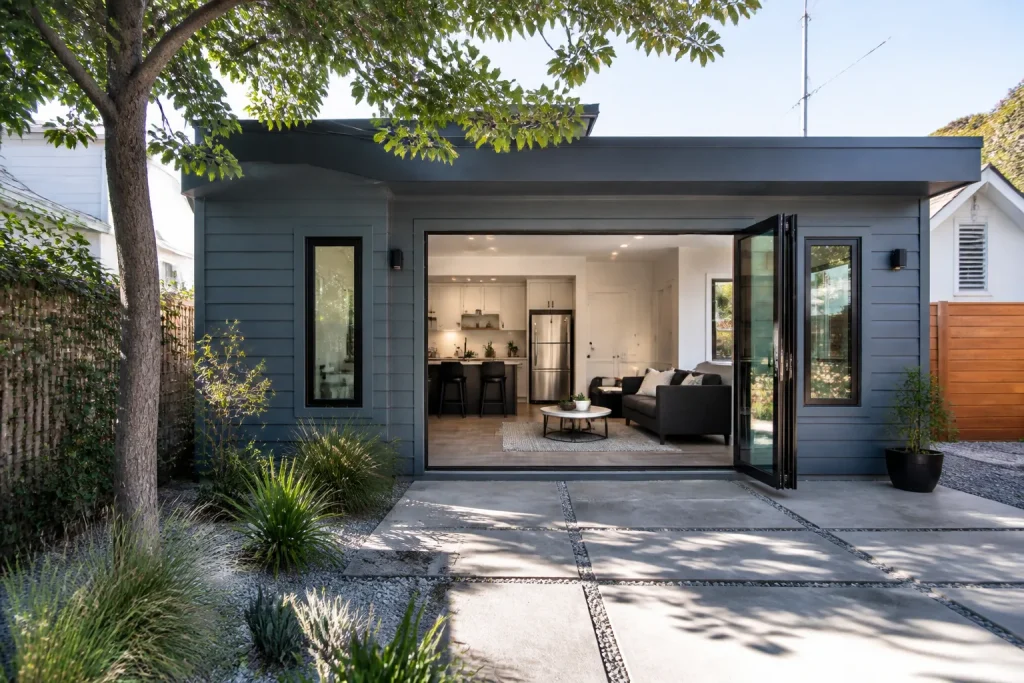
Dvele’s core promise is factory precision. Wall panels are assembled indoors, away from weather, with tighter tolerances than most site-built framing. The company puts real emphasis on air sealing, insulation, and energy performance, which is why their envelope often outperforms a standard addition. That part of the pitch is legitimate.
What Dvele does not deliver is the part of the job that happens outside the factory: the soils report for your specific lot in Los Angeles, the structural connection between the new module and your old slab or raised foundation, the panel upgrade if your electrical service can’t carry the added load, the trenching for plumbing and sewer, and the interface flashing where new meets old. Those are local contractor responsibilities. Either Dvele coordinates them through a third-party general contractor, or you do. Either way, the cost lands on your invoice.
In our experience, that site-work gap runs anywhere from $85,000 to $190,000 on top of the factory quote for a typical Los Angeles addition, depending on soils, foundation condition, and utility access. Before permit fees. That’s not a knock on Dvele. It’s just the reality of building in Los Angeles, where the dirt under your house has more say in the price than the factory that built your walls.
- Dvele handles: wall panels, windows, insulation, air sealing, interior finishes, factory QA
- You or a local GC handles: foundation assessment, structural tie-in, utilities, permits, site prep, delivery coordination
LA-Specific Permitting That Applies No Matter How the Room Is Built
Every room addition in Los Angeles goes through the same three-step gauntlet: architectural drawings stamped for LA, structural engineering for the foundation connection, and a Title 24 energy compliance report. None of these care whether your wall panels were built in a factory or framed on site.
LA Building & Safety will not move faster because you bought a prefab module. You still need a licensed architect or engineer to stamp drawings that show the existing structure, the proposed addition, and how the two tie together. You still need a soils report if your lot is in a hillside zone or if the addition changes the load on your existing slab. You still need Title 24, which in Los Angeles means a registered energy consultant runs a model and certifies that the new space meets current code for insulation, windows, HVAC, and lighting.
If your home is in a designated historic district (Hancock Park, Windsor Square, parts of West Adams), the drawings may trigger an additional design review layer. That’s site-specific, not factory-specific, and it applies to every build method equally.
- Architectural plans stamped for LA Building & Safety
- Structural engineering for foundation and seismic connection
- Title 24 compliance report from a registered energy consultant
- Soils report if required by the site’s geotechnical zone
The practical takeaway: when a prefab company advertises a “permitting package,” ask what it actually includes. Some include only the module drawings, which the city will reject without the site-specific conditions added. Others legitimately include the full plan set. Get it in writing before you write a check.
Foundation Compatibility: The Thing Prefab Marketing Usually Skips
The honest answer is that some Los Angeles lots are bad candidates for any addition, prefab or site-built, without significant foundation work. Hillside properties in Silver Lake or Mount Washington sit on expansive soils or fill. Older slabs in Mid-City or the Valley have been cracking for sixty years. If your existing foundation can’t handle the added load, you’re paying for underpinning or pier work before the first module ever shows up.
That cost range in Los Angeles is real money: $25,000 to $70,000 for typical foundation repairs and upgrades on a standard addition, more on hillside lots where grading and retaining walls enter the picture. The factory quote doesn’t include it because the factory hasn’t seen your dirt. We have. We’ve walked onto lots in Eagle Rock where the soil report came back so bad the homeowner scrapped the addition entirely and converted the garage instead.
Before you commit to a prefab path, pay for an independent soils report and a foundation assessment from a local structural engineer. It’s a $3,000 to $6,000 investment that can save you from a $60,000 surprise. Any contractor worth hiring, including us, will tell you to do this before you sign anything.
Who Runs the Site When the Module Shows Up?
This is the coordination question prefab buyers rarely ask until it’s too late. A Dvele module arrives on a truck. Somebody has to have the crane ready. Somebody has to have the foundation bolts placed to match the module’s exact dimensions, which means the foundation contractor needed the factory drawings six weeks earlier. Somebody has to schedule the electrician, the plumber, and the framer who closes up the seam between old and new. Somebody has to pull the electrical meter, coordinate the LA DWP, and get the final inspection signed off.
If you’re working with a local Room Addition Contractor in Los Angeles, that person exists and their name is on a contract. If you’re buying directly from a factory, that person may be you. Some prefab companies maintain preferred GC networks. Others tell you to find your own. Neither model is wrong, but you should know which one you’re buying before you buy it.
When we handle a prefab or modular addition in Los Angeles, we act as the licensed GC. We manage the crane, the subs, the inspections, and the final connection. We’ve worked with Dvele, Abodu, Cover, Mighty Buildings, Boxabl, and Plant Prefab platforms, and we match conventional materials like James Hardie siding when the lot or the budget calls for it. The Garrison Standard applies to every one of them: written price before any work starts, permits pulled by the book, and a one-year written guarantee when the job is done.
Questions to Ask Any Contractor Before Comparing Quotes
Here’s the evaluation framework we wish every homeowner in Los Angeles used before comparing prefab and site-built quotes. Ask all five questions, to every bidder, in writing.
- What exactly does this price include? Foundation, utilities, permits, site work, delivery, crane, final connection, and warranty, all in one number. If any line item says “by others,” find out who “others” is and what they charge.
- Who pulls the permits? If the answer isn’t “we do” or “our licensed GC does,” walk. Los Angeles will not issue a permit to an unlicensed owner-builder who then hires a factory. Somebody with a California license has to own the permit.
- What happens when the module doesn’t match the foundation? This happens more often than anyone admits. Factory tolerances are tight. Foundation tolerances are not. Who eats the cost of the fix?
- What does the warranty actually cover? A factory warranty covers the module. It doesn’t cover the seam between the module and your house. That’s a site-built condition, and it’s where leaks happen.
- Can I see three completed projects in Los Angeles? Not renderings. Finished projects with homeowners who will take your call. If they won’t give you references, that tells you what you need to know.
We pulled a 900-square-foot addition out of a pocket listing in Atwater Village last year where the homeowner had signed a prefab contract without asking any of these questions. The utility coordination alone added eleven weeks and $38,000. The addition turned out fine in the end, but the price the homeowner approved on day one was not the number on the final invoice. That’s the exact failure mode the written-price-first policy at Fielding ADU Builders exists to prevent.
The Bottom Line
Dvele builds a solid product. The factory precision is real, and for the right Los Angeles lot, the prefab route can save you time on framing and weather delays. But the site-specific work, the foundation, the utility tie-ins, the permits, the final connection, is the same no matter how the building was made. That’s where the budget moves. That’s where the timeline stretches. And that’s where a local contractor with a written price and a written guarantee makes the difference.
If you’re in Los Angeles and trying to decide between prefab and site-built, Fielding ADU Builders home is the place to start. We’ll walk you through the options honestly, including which build method suits your lot and budget, and we’ll put the number in writing before anything starts. Estimates are free. Call (361) 315-4177.
Related services in Los Angeles: Garage Conversion Contractor in Los Angeles | ADU Builders in Los Angeles
Frequently Asked Questions
A Dvele addition in Los Angeles typically runs $350 to $550 per square foot for the factory module, plus $85,000 to $190,000 in site work, foundation, utilities, and permits depending on your lot’s soils and existing foundation condition. That site-work number is independent of the factory price and is where most budgets break. Call (361) 315-4177 for an exact quote after we’ve seen your lot.
With a written price before any work starts, the number you approve on day one is the number on the final invoice. That’s the Fielding ADU Builders policy under The Garrison Standard: no change orders hiding in the middle of the job. If site conditions require a change, it goes in writing and gets your approval before any work continues.
Yes. Fielding ADU Builders pulls the permits for every addition we build in Los Angeles, including prefab and modular projects. Permits get pulled by the book, inspections get passed, and the final sign-off is yours before the job closes out.
Factory production for a Dvele module runs six to nine months. Site work and utility connection typically add three to five months after delivery. Total timeline in Los Angeles: ten to fourteen months from signed contract to final inspection, with the permitting phase consuming the first two to four months regardless of build method. Call (361) 315-4177 and we’ll give you a realistic schedule for your specific lot.
Written by Reed Calloway, Owner at Fielding ADU Builders, serving Los Angeles since 2006.
Need ADU Help?
Call Fielding ADU Builders - licensed & insured, here with fast after-hours help in Los Angeles.
(361) 315-4177