Last updated October 9, 2026
How to Hire a ADU Contractor in Los Angeles: A Step-by-Step Guide
Most homeowners who get burned on an ADU project didn’t hire a stranger off the street. They hired someone with a clean website, a Yelp profile, and a verbal promise of a six-month timeline. Two years later, the permit board is still blank and the price has doubled. Los Angeles is dense with contractors who talk a good game and deliver a stalled job site. This guide walks you through how to qualify a contractor before you ask for a bid, so you never end up standing in an unfinished backyard addition wondering what went wrong. By the end, you’ll know the four questions that eliminate most bad actors, how to read a CSLB license record, and why in Los Angeles the cheapest ADU bid is almost never the safest.
Quick Answer
To hire an ADU contractor in Los Angeles, start by verifying their CSLB license class, bond amount, and complaint history, then ask four questions before inviting anyone to bid: who pulls the permit, is the price in writing and fixed, what does the written guarantee cover, and can you speak to a client from a project permitted in the last 18 months. A real ADU contract in California must include the project scope, payment schedule, start and end dates, and change-order rules. Qualify contractors before comparing bids, because three bad bids from the wrong pool just gives you three bad options.
Table of Contents
- Step 1: Check the CSLB License, Not Just That a Number Exists
- Step 2: Ask the Four Questions Before Anyone Sends a Number
- Step 3: Understand Why the Lowest Bid in Los Angeles Almost Always Fails
- Step 4: Read the Contract Like a Los Angeles Building Inspector Would
- Step 5: Spot the Deposit-Funding-Another-Job Red Flag Before You Sign
- Step 6: Choose the Build Method That Fits Your Lot and Budget
- Step 7: Get the Price in Writing Before the First Nail Moves
Step 1: Check the CSLB License, Not Just That a Number Exists
Anyone with a laminated card can point to a license number. In Los Angeles, that number means something only when you look up what’s behind it. The California Contractors State License Board (CSLB) keeps a public database that shows more than whether a license is active. It shows the classification, the bond amount, the workers’ comp status, and every complaint that has ever been filed against the contractor.
Here’s what to check on the CSLB license lookup, in the order it matters:
- Classification. An ADU is a General B (Building) or a Residential Remodeling (B-2) classification. If the license says C-36 plumbing or C-10 electrical, you are not talking to a general contractor. A specialty license holder cannot legally pull an ADU permit.
- Bond amount. California requires a $25,000 contractor license bond as of 2023. If the bond is lower, walk. If it’s higher, that’s a signal the contractor has had claims filed against them before and the bonding company raised the rate.
- Complaint history. The CSLB records every complaint filed, even the ones that were resolved in mediation or dropped. One old complaint from 12 years ago is different from three complaints in the past two years. Reading complaint history tells you what the contractor does when things go wrong.
- Workers’ comp status. If the contractor has no workers’ comp and an unlicensed worker gets hurt in your Los Angeles backyard, that claim lands on your homeowners insurance. A contractor who cuts corners on insurance cuts corners elsewhere.
- Business name and address. Does the name on the license match the name on the business card? Does the address resolve to an actual Los Angeles address, or a P.O. box in Nevada?
In our experience in Los Angeles, the homeowners who skip this step are the ones who end up with a stalled slab and a contractor who stopped answering. The CSLB lookup takes ten minutes. The average ADU project is a six-figure job. That math isn’t hard.
Reed Calloway, who runs Fielding ADU Builders, has spent nearly two decades watching Los Angeles homeowners learn this lesson the hard way. The companies that survive in this market are the ones that welcome a license check, not the ones that deflect it.
Step 2: Ask the Four Questions Before Anyone Sends a Number
Most ADU hiring advice tells you to get three bids. That advice assumes all three bids come from contractors who are equally qualified to do the work. In Los Angeles, that assumption is wrong. The real filter happens before the bid, with four questions that take five minutes to ask and eliminate most of the bad players in the room.
Question 1: Who pulls the permit?
If the answer is “we’ll handle it,” you’re on the right track. If the answer is anything else, that’s a problem. In Los Angeles, the contractor named on the permit is the contractor legally responsible for the work. Some homeowners agree to pull an owner-builder permit to save a few hundred dollars, then find out their contractor walked off the job and the city is looking at them for the code violations. A contractor who asks you to pull the permit is telling you, in plain terms, they do not want legal responsibility for your project.
Question 2: Is the price written and fixed?
A verbal price is not a price. A written price that says “estimated” at the top with a note that says “actual costs may vary” is also not a price. The legitimate answer is simple: “Yes, the price goes in writing before any work starts, and the number you approve is the number on the final invoice.” If a contractor hesitates on this question in Los Angeles, do not invite them to bid.
Question 3: What does your guarantee cover in writing?
Most contractors say they stand behind their work. Few can show you the piece of paper that spells it out. Ask this: “If the roof leaks or the drywall cracks in month nine, what is the written guarantee, how long does it run, and what exactly do you fix?” A legitimate answer names the term and the process. The Garrison Standard, which Fielding ADU Builders operates under, covers workmanship defects for 365 days. If something fails inside that year, we come back and make it right at no charge. That promise is on paper, not in a handshake.
Question 4: Can I speak to a client from a project permitted in the last 18 months?
Any contractor can hand you a glowing reference from a job completed eight years ago. That tells you what the company used to be. You need to know what the company is now, which means talking to a homeowner whose Los Angeles ADU was permitted and inspected in the last year and a half. If the contractor can’t produce one, that either means no recent permits or no recent happy clients. Either way, you have your answer.
Step 3: Understand Why the Lowest Bid in Los Angeles Almost Always Fails
The lowest ADU bid in Los Angeles almost always reflects one of two things: unlicensed subs, or a plan that quietly leaves out the permit, the site work, or the utility connections until after you’ve signed. Sometimes all three.
Here’s how the math works. An ADU in Los Angeles typically runs $150,000 to $450,000 depending on build method, lot condition, and scope. A garage conversion is often $80,000 to $200,000 before permit fees. When one bid comes in 30% below the others, that gap has to come from somewhere:
- Unlicensed subcontractors. A licensed general contractor in Los Angeles pays workers’ comp, liability insurance, and legal wages. A contractor using unlicensed day labor pays none of that and passes the savings to you, then leaves you holding the claim when someone gets hurt on your property.
- No permit in the plan. Pulling permits in Los Angeles costs money in fees, plan checks, and inspections. A bid that “doesn’t include permits” is a bid that plans to build illegally. When the city finds out, the work gets red-tagged and you pay to fix it.
- Scope creep in the fine print. The low bid quotes a shell. It leaves out the electrical panel upgrade, the sewer tie-in, the retaining wall, the foundation work, or the site drainage. Those line items appear as “change orders” later, and the final invoice lands above the highest bid.
In Los Angeles specifically, the building department is not forgiving. Unpermitted work on an ADU gets flagged at resale, forces the work open, and in many cases costs more to correct than it would have cost to do it right the first time. Our Room Addition Contractor Maintenance Checklist for Los Angeles Homeowners can help you stay on track after the build. A low bid that doesn’t permit is not a deal. It’s a liability with a lower sticker price.
Step 4: Read the Contract Like a Los Angeles Building Inspector Would
California law requires certain things in a home improvement contract, and many one-page “proposals” you’ll see on a Los Angeles kitchen table don’t include them. The contract is not a formality. It’s the document that decides what happens when the project goes sideways.
A legitimate ADU contract in California must contain at minimum:
- Full project scope. Not “build ADU.” The scope should name the square footage, the build method (conventional, prefab, modular), the fixture allowances, the foundation type, and the finish level.
- Payment schedule. California caps the down payment on a home improvement contract at 10% of the total or $1,000, whichever is less. A contractor in Los Angeles asking for 30% or 50% down is violating state law.
- Start and end dates. Not “about six months.” A specific start date and a specific projected completion date, with language that explains what happens if the schedule slips.
- Change-order rules. What happens when something changes mid-project? The contract should say that any change to scope or price goes in writing, gets signed by both parties, and gets attached to the original contract before the work changes.
- Permit responsibility. Who pulls the permit, who pays for the permit fees, and who is named as the contractor of record.
- Warranty language. What is covered, for how long, and what the remedy process looks like. This belongs on paper, in the contract, not in a conversation.
What’s almost always missing from the one-page proposals we’ve seen in Los Angeles: a notice of the contractor’s right to file a mechanic’s lien, the change-order process, and the specific performance language that protects you if the contractor disappears mid-project. If the proposal fits on one page and doesn’t mention any of this, you are not looking at a contract. You’re looking at a quote.
Step 5: Spot the Deposit-Funding-Another-Job Red Flag Before You Sign
The most common way a Los Angeles homeowner gets burned on an ADU is not outright fraud. It’s the cash-flow death spiral: the contractor takes your down payment to cover payroll on a previous job, falls behind on that job, takes a larger deposit from the next client to cover yours, and the schedule slips further with every new signature. Following a clear Room Addition Contractor Maintenance Schedule: What to Do and When helps you catch warning signs early.
Here are the red flags that show up before you sign:
- A deposit demand above 10%. California law caps the initial down payment on a home improvement contract at 10% of the total or $1,000, whichever is less. A contractor in Los Angeles asking for 30%, 40%, or 50% down is either unaware of the law (which means you shouldn’t hire them) or is using your money to bail out another job (which means you definitely shouldn’t hire them).
- A payment schedule front-loaded before work is done. If the schedule says “50% at start, 30% at framing, 20% at completion,” the contractor has collected 80% before the project is halfway through the risk. The payments should track completed milestones, not calendar dates.
- Hesitation when you ask about the deposit clause in the contract. A contractor who knows the law will point to the 10% cap without blinking. A contractor who plans to squeeze you will talk around it.
- Slow start after a fast close. If the contractor signs the contract, takes the deposit, and then takes three weeks to show up at your Los Angeles property, that’s the sound of your money funding someone else’s punch list.
The fix is to insist on a payment schedule that ties every payment to a completed, inspected milestone. Payment after foundation inspection. Payment after framing inspection. Payment after the final sign-off. Every dollar you release should be tied to work the city of Los Angeles has already looked at and approved.
Step 6: Choose the Build Method That Fits Your Lot and Budget
Los Angeles is not one market. A flat lot in the Valley builds differently from a hillside lot in Echo Park, and a backyard that can take a crane builds differently from one that can only be reached through a 36-inch gate. The right contractor talks through the build method as part of the bid, not as an afterthought.
The main options in Los Angeles right now:
- Conventional stick-built. Framed on site, built to the lot, with trades coordinated over several months. Most flexible, most common, and most dependent on the contractor’s scheduling discipline.
- Prefab panelized. Builders like Plant Prefab and Boxabl manufacture the components off-site and assemble them on your Los Angeles lot. Faster on-site timeline, less weather exposure, and tighter material waste than conventional framing.
- Modular studio. A Tuff Shed-style structure permitted as an ADU works for simple one-bedroom backyard units. The cost per square foot is lower, the permit path is shorter, and the finish level is what you would expect from a manufactured structure rather than site-built carpentry.
- Cladding and finish systems. Whether you go prefab or conventional, materials like James Hardie fiber cement siding hold up better in Los Angeles sun and wildfire-prone zones than wood or vinyl. If the bid specifies the cladding, that’s a sign the contractor knows what Southern California does to a wall assembly.
The build method changes the cost, the timeline, and the permit path. It also changes which contractors you should be talking to. A contractor who only builds conventional won’t know how to run a crane day on a Plant Prefab module. A contractor who only sells prefab won’t know how to deal with a 100-year-old Los Angeles lot with an irregular setback. Fielding ADU Builders works with prefab platforms and conventional builds both, because the right answer on one lot is the wrong answer on the next one.
Step 7: Get the Price in Writing Before the First Nail Moves
The single most reliable predictor of a successful ADU project in Los Angeles is whether the price is in writing before any work starts. Not an estimate. Not a proposal that says “subject to final measurements.” A written price.
The Garrison Code, which Fielding ADU Builders follows on every project, starts with this: show up in the window, put the price in writing, build by the book, leave it clean, and stand behind it for a year. The price on the paper you sign is the price on the final invoice. No change orders for things the contractor should have caught during the bid. No line items that “surprised us” during framing. No “we’ll settle up at the end.”
Here’s what a written, fixed price should cover in Los Angeles:
- Permit fees, plan check fees, and school district fees (where applicable)
- Site work: demolition, grading, utility trenching, foundation
- Structural framing or prefab module delivery and set
- Roofing, cladding, windows, and doors
- Electrical, plumbing, and HVAC rough-in and finish
- Insulation, drywall, paint, and flooring
- Final clean-up and debris hauling
- The written guarantee, with the term and the make-it-right process spelled out
If a contractor in Los Angeles cannot give you a written price that covers the full scope before work starts, they are not offering you a price. They’re offering you a starting point and a series of surprises. The homeowners who avoid that outcome are the ones who demand the number on paper first, and read the paper before they sign.
Common Mistakes to Avoid
- Getting three bids before qualifying three contractors. In Los Angeles, three bids from the wrong pool just gives you three bad numbers. Qualify first, then bid.
- Signing a contract that doesn’t name the permit holder. If you’re pulling the owner-builder permit, you’re the contractor of record. That means you own the liability, and the city will look to you when the work fails inspection.
- Paying a deposit above 10%. California caps the down payment on home improvement contracts at 10% or $1,000, whichever is less. If the contractor asks for more in Los Angeles, that’s not a standard practice. That’s a red flag.
- Accepting a verbal guarantee. “I stand behind my work” is not a remedy. The written guarantee should name the term, the coverage, and the process for making it right.
- Skipping the CSLB complaint history. The license is active, so the contractor must be fine? Not how it works. Read the complaints, the bond amount, and the workers’ comp status.
- Choosing the bid that leaves out the permit. Unpermitted ADU work in Los Angeles gets flagged at resale, forced open, and often costs more to correct than to have permitted in the first place.
- Ignoring the change-order clause. If the contract doesn’t say changes go in writing, the contractor can claim you approved scope changes verbally. You didn’t, but now you’re paying for it.
When to Call a Professional
If your Los Angeles lot has a setback issue, a slope, an old sewer line, or an electrical panel that hasn’t been touched since the Nixon administration, don’t try to work around it with a contractor who doesn’t know how to handle it. Our Room Addition Contractor Troubleshooting: Common Problems and How to Fix Them covers these exact scenarios. A setback variance (the city’s written permission to build closer to the property line than the standard rule allows) takes a contractor who has navigated the Los Angeles Department of Building and Safety before. A hillside foundation takes a soils report and a structural engineer. If the contractor can’t name those two things in the first call, keep looking. Fielding ADU Builders offers free estimates in Los Angeles – call (361) 315-4177 and a live person answers.
Frequently Asked Questions
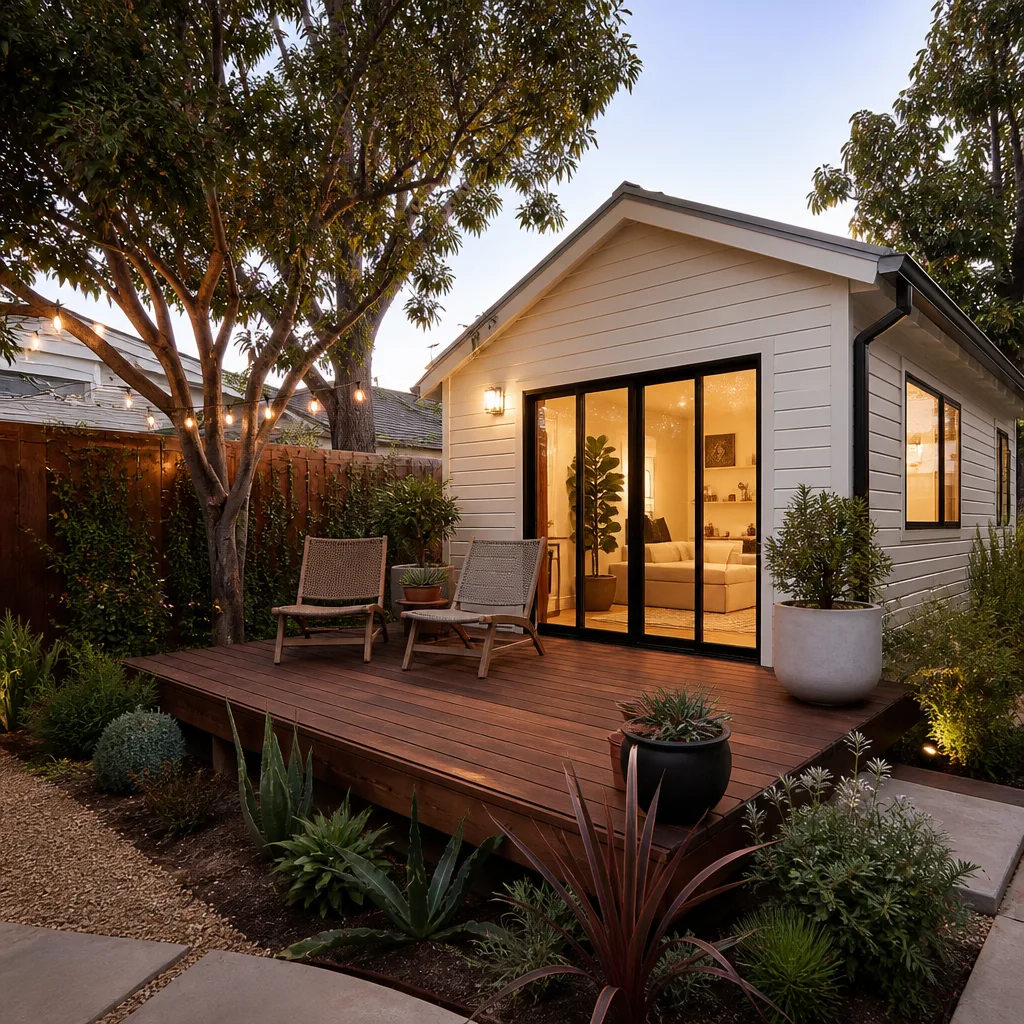
An ADU in Los Angeles typically runs $150,000 to $450,000 depending on build method, lot condition, and finish level, while a garage conversion runs $80,000 to $200,000 before permit fees. Prefab and modular options can reduce the on-site timeline but don’t automatically reduce the total cost once site work and utility connections are included. Call (361) 315-4177 for a written, fixed-price estimate specific to your lot.
A conventional ADU in Los Angeles typically takes 8 to 14 months from permit submittal to final inspection, while a prefab module can compress the on-site construction phase to 3 to 5 months. The biggest variable is the city: Los Angeles Department of Building and Safety plan check times have stretched project timelines for years. Get the schedule in writing with the same specificity as the price.
In California, the maximum down payment on a home improvement contract is 10% of the total contract price or $1,000, whichever is less. Any Los Angeles contractor asking for more than that on an ADU project is violating state law, and that’s not a contractor you want running your six-figure build.
Yes. Every ADU in Los Angeles requires a building permit from the Los Angeles Department of Building and Safety, and the contractor named on the permit is the contractor legally responsible for the work. A bid that doesn’t include the permit is a bid that plans to build illegally, and unpermitted work gets flagged at resale and forced open.
A legitimate ADU contract in California must contain the full project scope, a payment schedule that respects the 10% down payment cap, start and end dates, change-order rules in writing, permit responsibility, and the warranty language. If the proposal fits on one page and doesn’t mention change orders or permits, you’re looking at a quote, not a contract.
Yes, and many homeowners in Los Angeles do. Builders like Plant Prefab and Boxabl manufacture components or entire modules off-site, and companies like Tuff Shed offer permitted studio structures for simpler one-bedroom ADUs. The right build method depends on your lot access, your budget, and your timeline, and the best contractor for you is one who can talk through the trade-offs in plain terms. Call (361) 315-4177 to discuss which path fits your property.
The Bottom Line
Hiring an ADU contractor in Los Angeles is not about comparing three numbers. It’s about qualifying the contractors before the numbers arrive. Check the CSLB license record, ask the four questions, read the contract for the clauses that protect you, and get the price in writing before the work starts. The homeowners who end up with a finished ADU and a final invoice that matches the first number are the ones who did the filtering up front. For more guides & resources, visit our blog. The Garrison Standard has been building to that standard since 2006, and Fielding ADU Builders operates by it on every project in Los Angeles. If you’re ready to talk to a contractor who puts the price in writing and stands behind it for a full year, call (361) 315-4177 for a free estimate.
Written by Reed Calloway, Owner at Fielding ADU Builders, serving Los Angeles since 2006.