James Hardie Garage Conversion ADU: The Los Angeles Owner’s Guide
We stock and install James Hardie siding, trim, and panel components for garage conversion ADUs across Los Angeles, with most replacement jobs running $1,200 to $4,800 depending on square footage and the condition of what’s underneath, and we typically schedule within 5 to 10 business days. The parts that actually fail on these conversions are rarely the panels themselves; what we see most often in Los Angeles is failed flashing at the transition points, cracked corners on HardieTrim boards, and moisture intrusion where the old garage slab meets new wall framing. If you have a James Hardie-clad garage conversion and you’re seeing bubbling paint, soft spots near the base, or cracked boards at outside corners, the part that failed is usually the flashing or trim, not the siding panel you’re looking at.
Most Los Angeles homeowners discover the problem the same way: a paint bubble near the bottom of an exterior wall, a corner board that’s split along its length, or a rust-colored drip stain running down from a window head. By the time it’s visible on the surface, the water has been working behind the sheathing for months. Getting the right James Hardie-compatible part matched to your existing installation matters because Hardie boards are sized by exposure, not just by width, and mixing product lines creates a joint that will fail again inside of two years.
Which James Hardie Models This Applies To
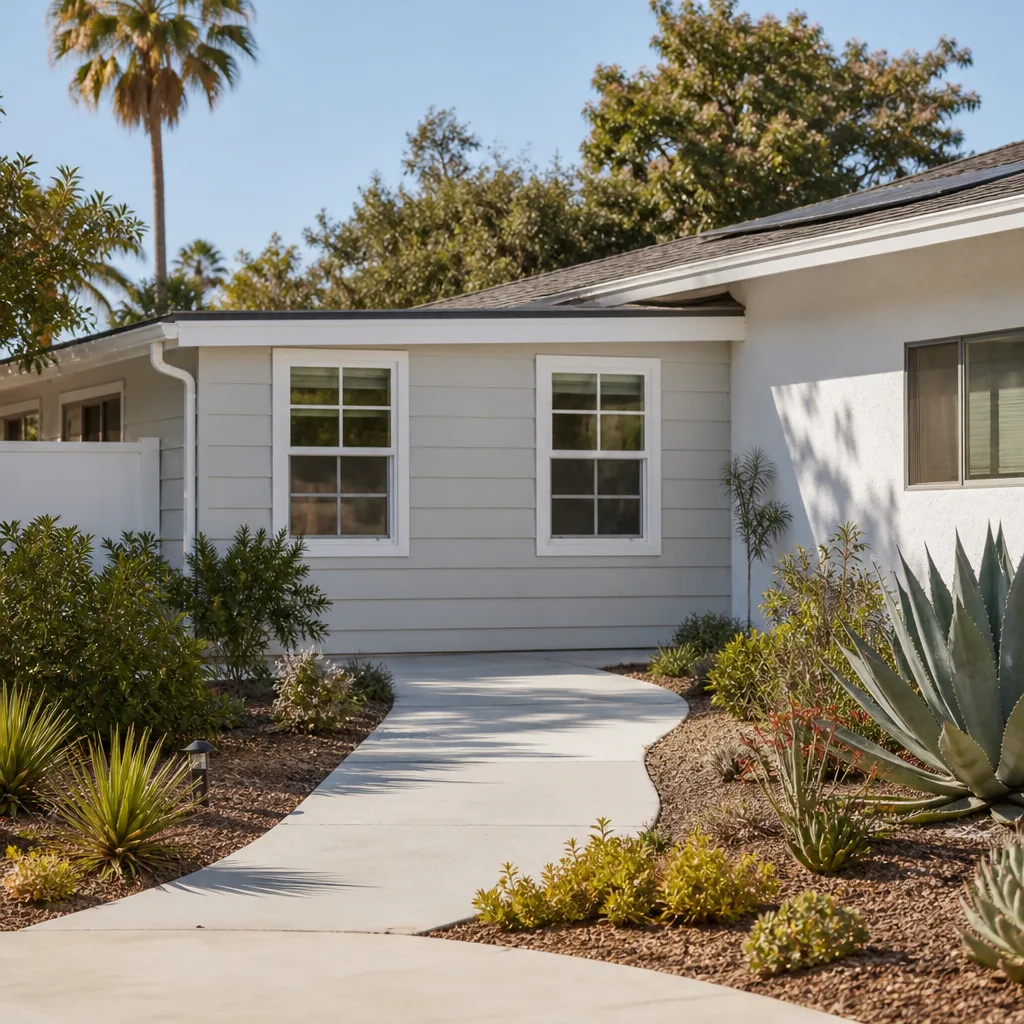
Most garage conversions in Los Angeles use James Hardie’s HardiePlank lap siding in a 5.25-inch, 6.25-inch, or 8.25-inch exposure, paired with HardieTrim boards in 4/4 (1-inch) or 5/4 (1.25-inch) thickness. The exact match matters. HardiePlank and HardiePanel are not interchangeable at the same dimensions; lap siding is installed with a specific overlap and panel siding is installed with a reveal, and mixing them across an ADU wall creates uneven shadow lines that water finds its way behind.
On the trim side, James Hardie’s HardieTrim boards come in smooth and cedar-textured finishes. Smooth boards in direct afternoon sun on a west-facing Los Angeles wall will crack at butt joints faster than textured ones because the smooth face reflects less heat and holds less movement tolerance. That’s the kind of detail you only learn by replacing enough of them. If your existing boards are stamped on the back face with a manufacturing code, match that code rather than guessing by eye; HardieTrim made before 2015 had a different density spec and wider boards tend to curl at the ends if you mix old and new cuts on the same wall.
For flashing, James Hardie does not make its own flashing products, but their installation spec requires corrosion-resistant flashing at every horizontal transition. In Los Angeles, where we get almost no freeze-thaw cycling but persistent UV and occasional heavy winter rain, galvanized steel flashing lasts longer than aluminum in coastal salt air if you’re within a few miles of the water. We stock both and spec them by location, not by habit.
One compatibility gotcha worth knowing: HardiePanel vertical siding used on ADU exterior walls needs a rainscreen gap behind it in Los Angeles coastal zones per current code, and homes built under older code often do not have one. If you are replacing a failed section of HardiePanel on a garage conversion built before roughly 2018, we check whether the wall assembly was updated at the time of the conversion, because re-siding over a non-vented wall on an uninsulated garage slab guarantees the same moisture problem returns within a few seasons.
Signs Your James Hardie Garage Conversion ADU Is Failing
- Bubbling or peeling paint at the bottom 12 inches of exterior walls. Water is wicking up from the slab or the base flashing was never installed. The fix is never just repainting; the lower course of siding or panel usually needs to come off to check the sill detail.
- Cracked or split HardieTrim at outside corners. Los Angeles heat cycles expand and contract the boards daily, and corner boards that were butt-jointed without a proper gap will crack along their length. Once split, water enters behind the siding plane.
- Rust-colored staining below window heads or door flashings. The metal flashing has corroded through or was lapped incorrectly. James Hardie’s install spec calls for head flashing over every opening, and a missing or backward lap shows up as a brown tear mark on the siding.
- Soft spots or delamination near the bottom of HardiePanel sheets. This usually traces to missing or failed Z-flashing at the horizontal seam between panel courses. Fiber cement wicks water slowly at cut edges, and a panel that stays wet at the cut edge will start to swell and crumble within 4 to 6 years.
- Gaps opening at trim-to-siding joints during summer afternoons. This is thermal movement, and it is normal for fiber cement. What is not normal is a gap that stays open after the wall cools. That signals improper fastening, not climate, and the board has likely lost structural purchase on the framing behind it.
Replacement Cost & What’s Included
For a typical Los Angeles garage conversion ADU, here is what replacement work runs before any unforeseen framing repair:
- Siding section replacement (single wall, 10 to 16 linear feet): $900 to $2,200
- Full HardieTrim corner replacement (one corner, both sides): $350 to $800
- Flashing replacement at one window or door head: $200 to $550
- Bottom-course siding and sill flashing replacement (one wall): $1,100 to $2,600
- Full re-side of one ADU exterior wall (including housewrap and flashing): $2,400 to $4,800
The spread comes down to what we find underneath. A clean removal where the sheathing is sound and the framing is dry is on the low end. Rot at the bottom plate, termite damage at the sill, or a slab that was never properly flashed runs toward the top end. The Garrison Standard governs this work, which means you get a written price before we touch the wall, and that number is the number on the final invoice. Every replacement we do is backed for one full year; if a trim board cracks or a flashing leaks inside 365 days, we come back and correct it at no charge.
We are an independent Los Angeles contractor, not affiliated with James Hardie, and we install their products along with materials from other manufacturers where the project calls for it.
DIY or Call Us?
You can safely check the obvious things from the ground: look for cracked corner boards, lifted paint near the slab, and brown staining under windows. Do not pull a board off. Once you remove fiber cement siding, you’ve broken the weather barrier behind it, and if you do not re-flash it correctly on the way back on, you have turned a cosmetic problem into a structural one inside a single rain season.
The dangerous version of this work is not the siding itself; it is what people do to reach it. Siding at eave height on a two-story garage conversion means ladder work against an existing wall, often near power lines at the service drop. That is where DIY sends people to the hospital. If the failure is at ground level and you are comfortable with a pry bar and a level, you can decide for yourself. If it is above 8 feet, call us at (361) 315-4177 and let our crew handle it.
Reed Calloway will tell you the same thing he tells his own crew: this is not complicated work, but it is unforgiving. Put it in writing, then go build it. That’s how we handle every James Hardie replacement we touch in Los Angeles.
FAQs
In Los Angeles weather, correctly installed HardiePlank and HardiePanel typically last 30 to 50 years before the boards themselves fail; what usually fails first is the paint at 10 to 15 years and the flashing at 15 to 20 years. The siding product is durable; the weak points in a garage conversion are the transitions where wood framing, old slab, and fiber cement meet. Call (361) 315-4177 for an honest assessment of whether you are facing a paint issue or a flashing failure.
No, a cracked fiber cement trim board cannot be structurally repaired by caulking or patching; the fiber cement matrix has lost integrity along the crack line and will re-split with the next thermal cycle. The board gets replaced, and we cut the new board with the proper expansion gap so the same stress does not transfer to the joint. Call (361) 315-4177 and we’ll give you a written price for the trim replacement.
A single-wall section replacement on a Los Angeles garage conversion ADU typically takes one day on site; a full re-side of one wall runs two to three days including housewrap, flashing, and paint-ready finish. Weather delays are rare in LA, but fiber cement should be cut with shears or a dust collection system rather than a standard circular saw due to silica dust, which adds a little time to every cut. Call (361) 315-4177 for a schedule estimate on your specific wall.
We stock the most common HardiePlank exposures, standard HardieTrim profiles, and galvanized and aluminum flashing on our trucks, so most Los Angeles replacement jobs are completed the same week we come out to look. Odd exposures, custom color caulks, and specialty trim profiles usually require a 3 to 7 day order from our local Los Angeles supplier. Call (361) 315-4177 to confirm availability for your existing product line.
Written by Reed Calloway, Owner, Fielding ADU Builders at Fielding ADU Builders, serving Los Angeles and nearby areas.